Tel: 650-980-4870

Blog
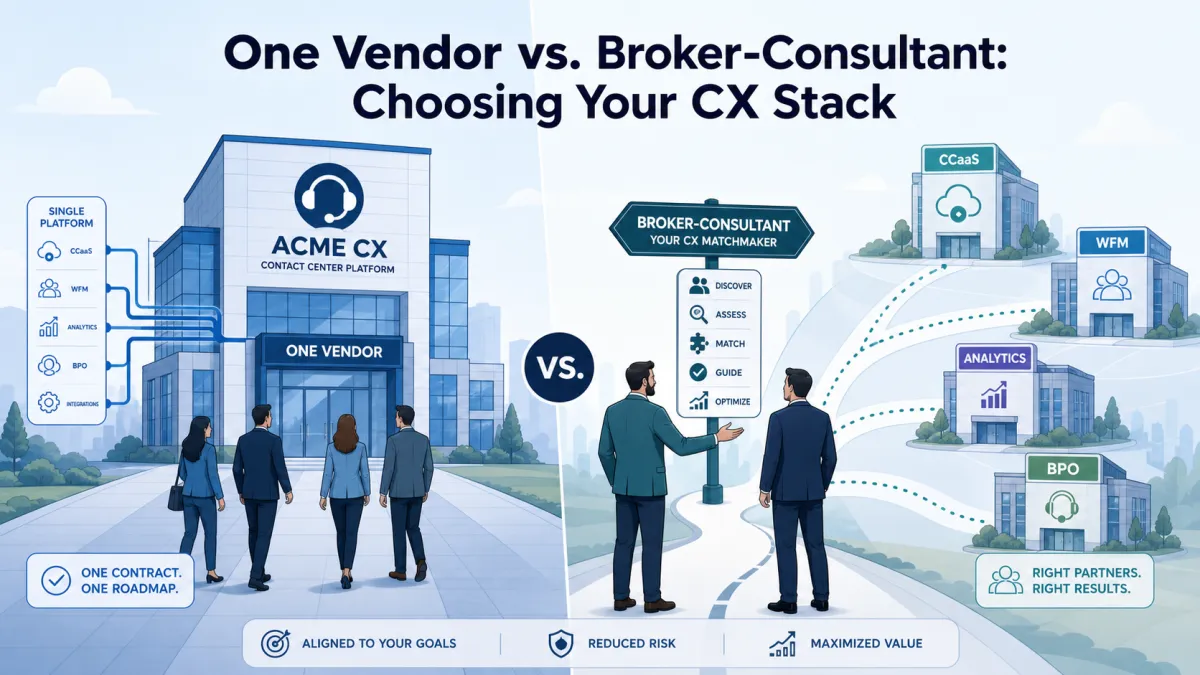
Single Vendor vs. Broker Consultant
One Vendor That “Does It All” vs. A Broker‑Consultant: Which Play Is Right For You?
When you are staring down a major CX or contact center decision, the choice often seems binary: pick a single vendor that claims to “do it all,” or bring in a broker‑consultant to navigate the market and assemble the right mix of solutions. On paper, both paths can get you to a working tech stack; in practice, they create very different futures for your business.
This post breaks down the real trade‑offs between the two approaches so you can align your buying strategy with your CX and operational goals, not just with whoever has the slickest demo.
What “Do‑It‑All” Vendors Really Offer
A “do‑it‑all” vendor promises simplicity. One platform, one contract, one implementation, one support relationship. For a busy leadership team, that is extremely attractive. You are not stitching together multiple systems or juggling several partners; you are buying a pre‑integrated experience.
In a contact center context, that usually means one provider for routing, IVR, digital channels, WFM, QA, reporting, and AI. The appeal is obvious:
Fewer vendors to manage and fewer integrations to maintain
A single roadmap to understand
Clear accountability when something breaks
However, that simplicity comes with hidden constraints:
You are locked into one roadmap. If their WFM or analytics lags the market, you inherit that gap.
You have limited leverage. It is harder to negotiate price or terms when most of your environment is concentrated in a single vendor relationship.
Your strategy can start to follow the product instead of the other way around. What is easiest inside their platform slowly becomes “the way we do things,” even if it is not the best way for your customers or agents.
A do‑it‑all vendor is a strong choice when your top priorities are speed, reduced complexity, and a single throat to choke—especially if your CX needs are relatively standard and you do not have a large internal architecture or vendor management function.
How Broker‑Consultants Change The Game
A broker‑consultant, by design, does not show up with one platform to sell. Their job is to represent your interests to the market, not one company’s interests to you. They make their impact by deeply understanding your business model, operating constraints, and KPIs, then translating those into a set of vendor and solution choices that actually fit.
Instead of starting with “here’s our product,” they start with questions like:
What are your top three CX and operational outcomes over the next 24 months?
Where do you feel over‑tooled or under‑tooled today?
How do regulatory, security, and data requirements shape your options?
What is your tolerance for vendor sprawl versus lock‑in?
From there, a broker‑consultant can:
Curate options across many platforms and services, including vendors you might not have on your radar
Run competitive sourcing events and negotiations with real benchmarks, not list‑price theater
Design an architecture where each component—CCaaS, WFM, QM, analytics, AI, BPO—earns its keep
In practical terms, that often leads to a “best‑fit, best‑of‑breed” stack: a primary CX platform from one provider, workforce tools from another, AI/analytics from a third, and potentially managed services or BPO capacity layered in where it makes economic and operational sense.
The Strategic Trade‑Offs Side‑By‑Side
Here is how the two models differ when you zoom out and look at the big levers that matter to executives.
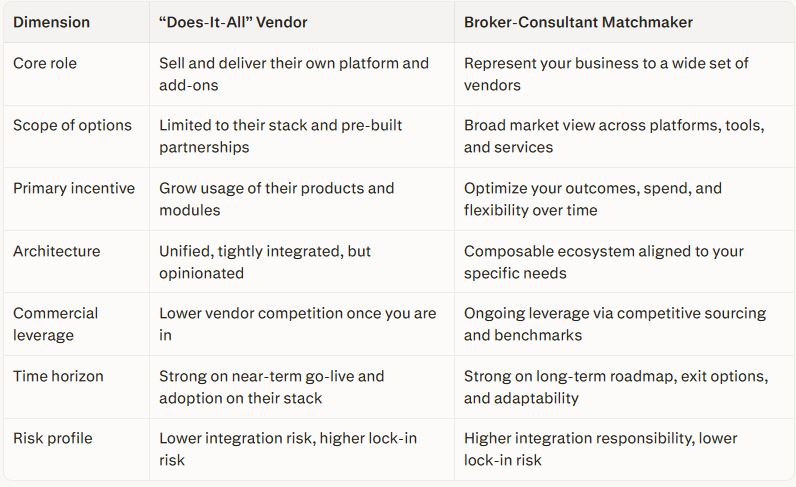
Neither approach is inherently “better.” Each is a different risk and control profile:
The do‑it‑all vendor minimizes the complexity you see, but maximizes your dependency on one provider.
The broker‑consultant increases the number of moving parts, but maximizes your ability to adapt, swap components, and keep vendors honest.
How To Decide What’s Right For Your CX Organization
The right answer depends heavily on where you are in your CX maturity journey and how much change you are prepared to manage.
A do‑it‑all vendor is usually the better move if:
You need to move fast and do not have strong internal solution architecture or vendor management capabilities.
You want to reduce the number of contracts, integrations, and stakeholder conversations.
You are comfortable aligning to a vendor’s roadmap and “way of working” for the next 5–7 years.
A broker‑consultant is usually the better move if:
Your environment is complex—multiple business units, channels, regions, or heavy regulatory constraints.
You want to treat CX and contact center technology as a strategic lever, not just an infrastructure cost.
You care about ongoing optimization: retendering, benchmarking, and selectively swapping components as the market evolves.
In reality, many organizations end up with a hybrid approach: they choose one or two strategic platforms as anchors, then work with a broker‑consultant to challenge vendor upsell, identify best‑of‑breed add‑ons, and maintain competitive tension in renewals and expansions.
The key is to be intentional. Do not let the “easy button” of a single vendor or the shiny promise of “unbiased” consulting make the decision for you. Start with your business outcomes, your capacity to manage complexity, and your appetite for vendor lock‑in—then choose the model that gives you the best shot at hitting your CX and financial targets.

Menu
Services
© Copyright 2023. Optimal Outcomes. All rights reserved.