Tel: 650-980-4870
Blog
Into Year End - What Else Can You Do
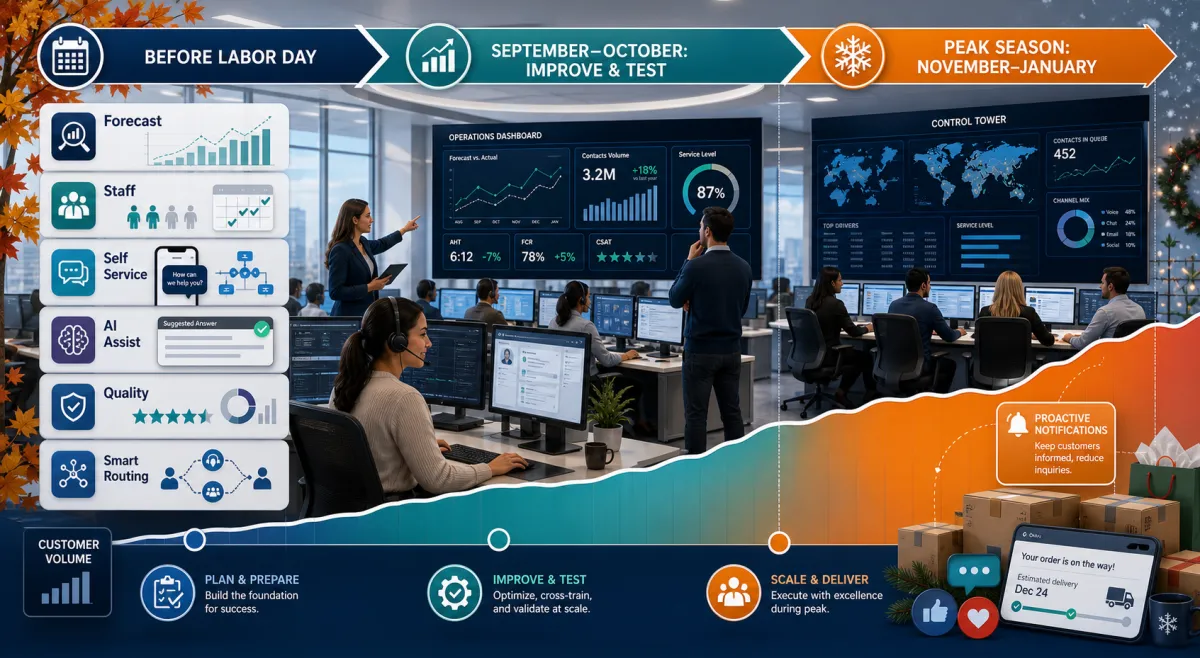
Before Labor Day, contact centers ideally should have completed most of the structural preparation for the remainder of the year: demand forecasting, staffing commitments, seasonal training design, technology readiness, and alignment with marketing, fulfillment, and policy teams. After Labor Day, the priority shifts to closing gaps quickly, simplifying customer journeys, and operating a disciplined peak-season control process.
The good news is that September remains a valuable intervention window. A center may not be able to build a fully trained seasonal workforce or replace its core platform in time, but it can still materially improve service levels, containment, agent productivity, and customer outcomes before the heaviest late-year demand arrives. Peak-planning guidance commonly places forecasting 12 weeks ahead, recruiting around 10 weeks ahead, onboarding/training around 8 weeks ahead, and system/knowledge-base refinements roughly 6 weeks ahead of peak.
What should have been done before Labor Day
1. Built a credible demand and capacity plan
The center should have created a weekly and intraday forecast covering September through January—not just expected call volume, but volume by:
Channel: voice, chat, email, messaging, social, and self-service
Contact reason: order status, delivery exceptions, billing, cancellation, returns, technical support, claims, account access, and so on
Customer segment or priority tier
Product line, geography, language, and time zone
Marketing promotion, product launch, billing-cycle, shipping, or fulfillment event
A useful plan joins historical contact data to the business events that cause contacts. For example, a retail or e-commerce center should connect forecasts to promotion calendars, web traffic, cart activity, inventory availability, shipping cutoff dates, and returns policy. Liveops notes the value of watching those real-time demand signals and shifting coverage accordingly.
The output should be a capacity plan that identifies requirements for productive hours, staffing by interval, occupancy, shrinkage, overtime, overflow, and contingency capacity—not simply a monthly headcount target.
2. Secured scalable labor capacity
By late August, leaders ideally had already:
Rehired strong prior seasonal agents where applicable.
Committed internal overtime, shift-bid, vacation blackout, and incentive rules.
Begun recruiting and training seasonal staff.
Cross-trained agents into high-volume queues and common digital channels.
Contracted BPO, gig, or specialist overflow capacity.
Confirmed multilingual, after-hours, technical-support, and escalation coverage.
Defined how quickly capacity could ramp if demand exceeded plan.
Flexible staffing can combine full-time, part-time, and contingent agents, with shorter shifts matched to demand curves; it is also important to identify the operational conditions under which those resources will be activated.
3. Prepared agents for peak-specific contacts
Training should have been narrow, scenario-based, and policy-current, rather than broad classroom training. The curriculum should cover:
Seasonal promotions, exclusions, stock availability, shipping cutoffs, and delivery exceptions
Returns, exchanges, cancellations, credits, and fraud/identity-verification procedures
New products, service outages, pricing changes, and policy exceptions
Empathy, de-escalation, and recovery authority for frustrated customers
Escalation routes and ownership rules
Knowledge-base navigation and correct use of agent-assist tools
Privacy, security, compliance, and quality requirements under higher handling pressure
The goal is not merely to reduce average handle time. It is to help agents resolve the most common seasonal reasons for contact accurately on the first interaction.
4. Removed avoidable contacts
Before Labor Day, a mature CX organization should have reviewed its top contact drivers and asked: Why must the customer contact us at all?
High-value preventive measures include:
Proactive order, shipping, delivery, outage, appointment, and billing communications.
Clear, current website and app content on availability, delivery estimates, returns, and policy changes.
Better self-service flows for order tracking, password resets, payment questions, appointments, and returns.
IVR and virtual-agent improvements focused on a small number of high-volume tasks.
Better routing based on intent, customer value, language, sentiment, or known issue.
Callback options when predicted wait times exceed a defined threshold.
Proactive outbound communication—such as shipping updates and return-policy reminders—can reduce inbound pressure during seasonal peaks, while AI-based routing and virtual agents can help manage the remaining demand.
5. Tested technology and governance
The center should have validated:
Telephony, CCaaS, CRM, WFM, QM, knowledge, chatbot, and authentication capacity.
Carrier capacity, network resilience, remote-agent connectivity, and failover procedures.
Integrations with order management, logistics, payment, identity, and fulfillment systems.
Queue configurations, routing logic, overflow rules, and callback functionality.
Dashboards, alert thresholds, incident ownership, and executive communications.
A peak-day “war room” process, including simulations of a material volume surge or a major customer-impacting failure.
Pre-peak simulations are useful because they expose operational gaps that normal daily performance can hide; NICE explicitly recommends war-room simulations and monitoring service level, average handle time, and abandonment in real time.
What can still be improved now
The most effective September work is usually not a large transformation program. It is a 30- to 60-day operational sprint aimed at the customer journeys most likely to create volume, dissatisfaction, repeat contacts, or revenue leakage.
Area | Action still feasible now | Likely impact |
|---|---|---|
Forecasting | Rebuild the remaining-year forecast using latest volume, backlog, demand drivers, promotions, and operational changes | Better staffing decisions and earlier warning of risk |
Staffing | Rebalance schedules, activate overtime/voluntary extra time, reopen internal transfers, cross-train agents, and finalize overflow arrangements | Fewer avoidable service-level failures |
Knowledge | Refresh the top 20–50 high-volume articles, eliminate conflicting guidance, add decision trees and macros | Faster, more accurate resolution |
Self-service | Improve the top 3–5 intents in IVR, chatbot, web, or app flows | Lower live-contact demand and better 24/7 support |
Routing | Prioritize urgent, high-value, vulnerable, or complex customers; route simple requests to self-service or appropriately skilled teams | Better use of scarce expert capacity |
Quality | Move from broad scorecards to daily checks on critical errors, policy adherence, empathy, and resolution | Reduced compliance and CX failures |
Customer communications | Publish proactive updates for predictable disruptions, delivery milestones, policy changes, and known issues | Fewer “where is my…” and status contacts |
Operations | Establish a daily peak huddle and a cross-functional escalation path | Faster decisions and recovery during disruptions |
A practical September playbook
First 10 business days: Diagnose and choose
Run a concentrated review of the data from the last 8–12 weeks plus the comparable prior peak period. Identify:
The top contact reasons by volume, cost, repeat-contact rate, customer dissatisfaction, and escalation rate.
Queues or intervals at risk of missing service level.
Contact types that should be deflected, automated, proactively communicated, or rerouted.
Staffing gaps by skill, channel, language, and hour of day.
Knowledge or policy ambiguity creating long handle times and transfers.
System bottlenecks, failure points, or manual processes that will not scale.
Then select a small number of prioritized interventions. Avoid launching 20 changes at once. A realistic target is three to five improvements tied to measurable outcomes.
Mid-September through October: Deploy quick wins
Focus on interventions that can be implemented, tested, and measured rapidly:
Fix the highest-volume customer intents.
If “Where is my order?” is 20 percent of voice traffic, improve tracking data, send proactive notifications, make tracking self-service easier to find, and create one concise agent workflow for genuine exceptions.Simplify agent work.
Create short “peak playbooks” for the top reasons for contact: a decision tree, required verification, approved exception options, escalation triggers, and suggested customer language.Use AI selectively and safely.
Deploy or tune agent assist for knowledge retrieval, interaction summaries, after-call-work reduction, and next-best-action guidance. For self-service, concentrate on narrow, transactional intents with reliable data rather than attempting a broad, untested conversational overhaul immediately before peak.Improve queue protection.
Establish callback thresholds, threshold-based overflow, skill-based routing, priority treatment for high-risk cases, and a clear protocol when the center falls behind.Run a peak simulation.
Simulate a 25–50 percent volume jump, a sudden delivery issue, a website outage, a policy change, or absent staff. Test technology, staffing, communications, escalation, and executive decision rights—not just call routing.
Seasonal planning guidance similarly emphasizes forecasting, flexible staffing, targeted training, and testing platform scalability.
November through January: Operate a control tower
During the actual peak, establish a simple daily operating cadence:
Intraday: Monitor forecast versus actual demand, service level, abandonment, wait time, backlog, occupancy, schedule adherence, transfer rate, repeat contacts, and customer sentiment.
Daily: Review the top emerging contact drivers, failed self-service journeys, agent questions, knowledge gaps, vendor/fulfillment issues, and any policy conflicts.
Weekly: Adjust staffing, overflow, digital content, routing, proactive communications, and executive priorities.
Post-event: Preserve findings immediately—before the details fade—and convert them into next year’s forecast, hiring, training, product, policy, and automation roadmap.
Metrics that matter most
Do not run peak season solely on average handle time. That can encourage rushed interactions, transfers, repeat contacts, and lower-quality outcomes. Balance speed with customer and operational effectiveness:
Forecast accuracy and interval-level staffing attainment
Service level, answer speed, abandonment, and callback completion
Backlog age by channel
First-contact resolution and repeat-contact rate
Transfer and escalation rates
Customer satisfaction, effort, complaints, and sentiment
Quality-critical errors, compliance failures, and policy exceptions
Self-service completion, containment, and failure-to-agent handoff rate
Agent schedule adherence, absenteeism, attrition risk, and occupancy
Cost per resolved customer issue—not simply cost per contact
The leadership message
The key distinction is between surviving volume and managing demand. Centers that only add people often still face long waits, uneven quality, burned-out agents, and repeat contacts. Centers that combine capacity with proactive communication, accurate self-service, current knowledge, focused quality controls, and fast cross-functional issue resolution are better positioned to protect both cost and customer trust.

Menu
Services
© Copyright 2023. Optimal Outcomes. All rights reserved.