Tel: 650-980-4870

Blog
2026 2H: What's hot, What's Not
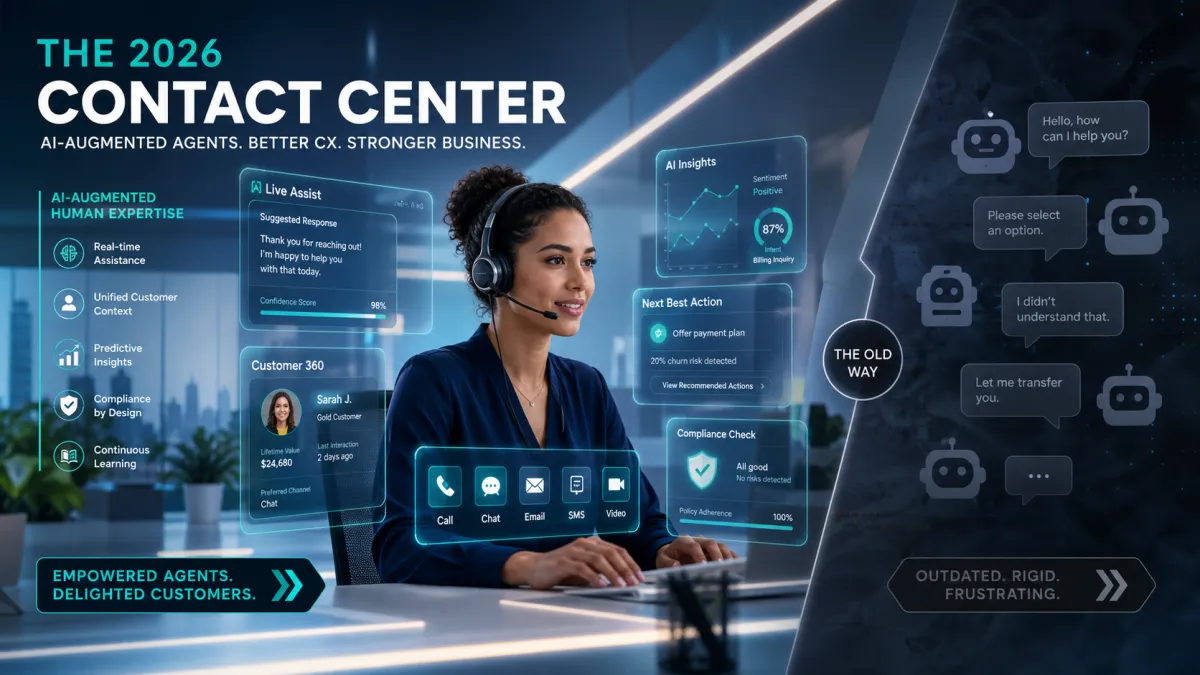
The most important contact center trend emerging in the second half of 2026 is not “AI” in the abstract, but the normalization of AI-augmented agents as the default operating model. The one that is most likely to fade is the narrative that fully autonomous, humanless contact centers will quickly replace agents at scale.
The breakout trend: AI-augmented agents as the new normal
In 2026, the center of gravity has moved from experimental chatbots and narrow pilots to AI being embedded directly into the agent desktop, routing, and workflows. Instead of AI experiments sitting off to the side, leading organizations are making AI an operational foundation that works alongside humans in real time.
Practically, that looks like AI copilots that surface next-best actions, summarize customer history, guide compliance, and suggest dispositions while the human agent remains in control of the interaction. It also means routing engines and analytics that continuously ingest context, intent, sentiment, and value, then feed that intelligence back into the live conversation. The result is a contact center that behaves less like a reactive cost center and more like a predictive, revenue-aware engine.
Analysts and platform providers increasingly describe 2026 as a “foundational” year for AI in customer service: less about moonshots and more about gritty work—data plumbing, workflow redesign, change management, and integration. That framing aligns directly with AI-augmented agents becoming the new standard: it is pragmatic, implementable with current technology, and compatible with existing governance and risk frameworks.
Why AI-augmented agents will actually stick
AI-augmented agents succeed because they match three realities: provable ROI, tolerable risk, and executable implementation paths.
On the ROI side, organizations are demonstrating meaningful reductions in handle time, improvements in first-contact resolution, faster ramp times for new hires, and higher consistency in compliance. AI copilots and workflow automation eliminate low-value cognitive load—manual note-taking, hunting for knowledge articles, toggling between systems—so the human can concentrate on judgment, empathy, and complex scenarios.
From a talent perspective, AI-augmented models also speak directly to the agent-experience problem. Burnout, churn, and difficulty staffing complex queues have been chronic issues; now, AI is being positioned not as a threat to jobs, but as a lever to simplify work, reduce stress, and raise the overall skill profile of the agent workforce.
Architecturally, the rise of composable, cloud-based contact center platforms makes this augmentation path much more realistic. Instead of all-or-nothing migrations, enterprises can plug in discrete AI services—assist, summarization, real-time coaching, routing intelligence—into existing tech stacks. That same composability underpins “compliance-by-design” and AI governance: it is easier to audit, control, and tune augmentation services than to manage a monolithic autonomous front end that owns the entire interaction.
In short:
Boards and CFOs can sign off because the business case maps cleanly to familiar KPIs.
CISOs and risk teams can live with it because humans remain in the loop and controls are explicit.
IT can deliver it because it aligns with current cloud, API, and event-driven architectures.
The fading trend: the fully autonomous, humanless contact center
The narrative that “AI will quickly replace the majority of contact center agents” is already hitting hard limits in 2026.
Early generative AI deployments have shown a consistent pattern: automating simple, transactional interactions works well and often lifts satisfaction, but over-automation of complex, emotional, or high-stakes journeys erodes trust and damages brand perception. Customers still expect empathy, nuance, and the ability to deviate from the script when the stakes are high or the situation is ambiguous.
At the same time, the operational and regulatory realities are sobering. As AI systems take on more frontline work, organizations run into issues like:
Hallucinations and wrong answers that are difficult to fully eliminate.
Compliance and audit requirements that demand traceability, explainability, and human oversight.
Security and fraud concerns, particularly as consumer-side AI tools begin to interact with corporate systems at scale.
These pressures are pushing serious operators toward hybrid, human-in-the-loop models rather than pure autonomy. Even where “autonomous agents” are deployed, they tend to handle bounded workflows with clear policies and low ambiguity—think address updates, simple billing adjustments, or structured claims—while anything interpretive or emotionally charged routes to a human.
Alongside this, a new layer of AI governance and “AI operations” is emerging: teams responsible for policy, tuning, monitoring, and exception handling. That is not what you create if you believe humans will rapidly disappear from the system; it is what you build when you expect humans and AI to coexist for a long time.
Taken together, these dynamics make the fully autonomous, humanless contact center narrative more of a short-lived hype phase than a durable strategic direction. The conversation is already shifting from “when will we replace agents?” to “how do we blend automation and human expertise in a controlled, measurable way?”

3 Key Takeaways
2026 is the year of AI-augmented operations, not AI takeovers
The ROI story is in augmentation, not elimination
The autonomy hype is already being tempered by risk and CX realities.

Menu
Services
© Copyright 2023. Optimal Outcomes. All rights reserved.