Tel: 650-980-4870

Blog
Software Platforms
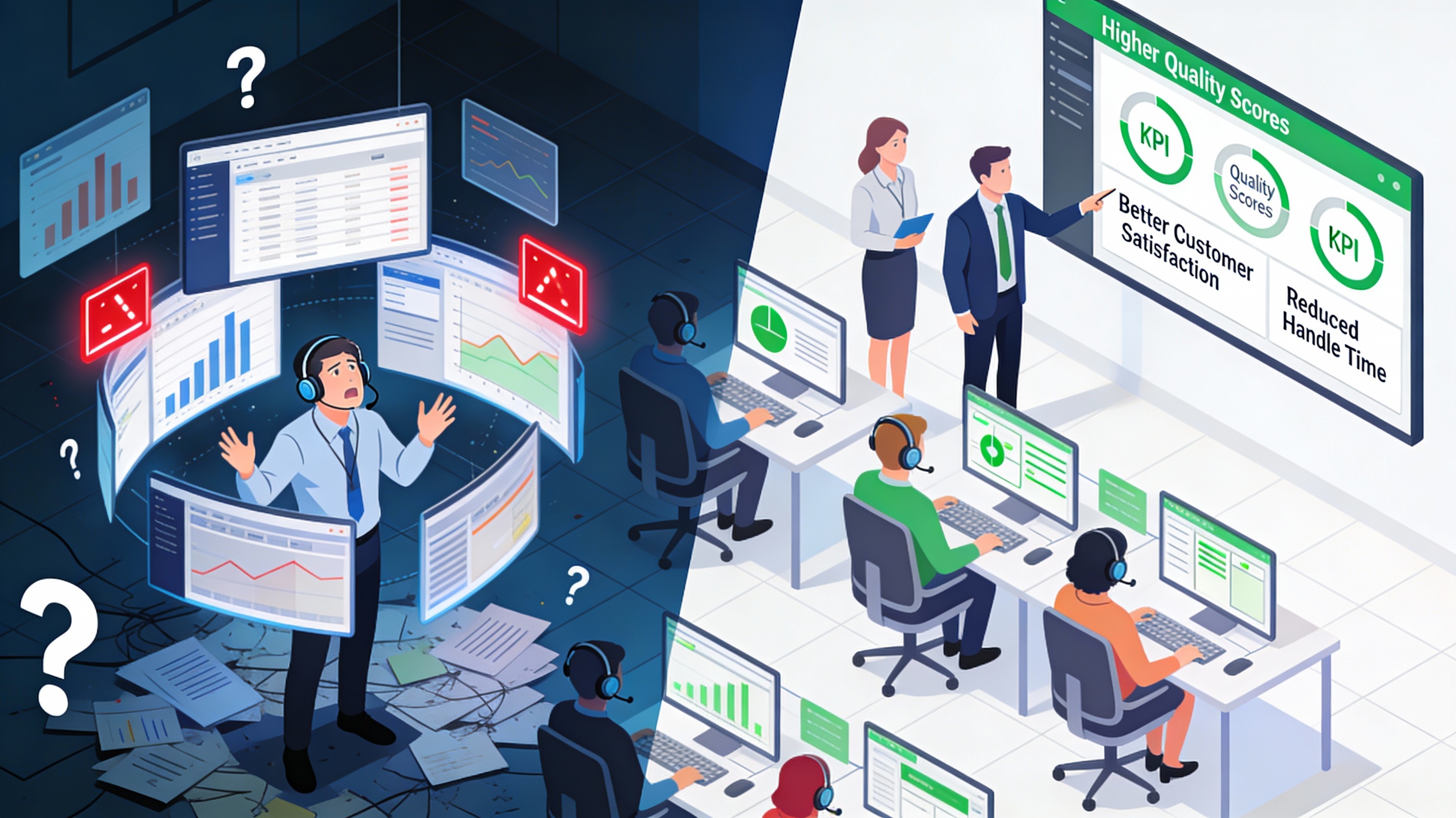
Many contact center software vendors build impressive platforms, but too often they lack the context and operational insight needed to solve real-world contact center problems. As a result, more organizations are turning to consultants and practitioners who live in contact centers every day—and to solutions born inside actual operations rather than in generic software roadmaps.
When software loses the plot
Most CCaaS and CX platforms were architected from a technology-first perspective: features, integrations, and AI capabilities come before a deep understanding of what happens on a Monday morning in a busy center. This leads to several recurring gaps:
Generic AI and analytics
Off-the-shelf AI often struggles with noisy audio, overlapping speech, accents, and real call dynamics, which limits its usefulness for coaching and quality.
Models tuned for “customer service” in general miss nuances like line-of-business rules, regulatory language, and brand-specific empathy standards.
Workflow blindness
Many tools optimize for isolated interactions (a single call, a chat) rather than the end-to-end journey across channels, transfers, escalations, and back-office delays.
Features look good in demos but create extra clicks, duplicate data entry, or parallel systems when dropped into complex, legacy environments.
Limited appreciation for frontline realities
AI “agent assist” can surface prompts too late in the conversation or overload agents with pop-ups, increasing cognitive load instead of reducing it.
Tools rarely reflect staffing constraints, handle times, wrap-up work, or the pressure of live service levels that define an agent’s day.
Why context matters in contact centers
Contact centers are not generic service desks; they are highly constrained, metric-driven environments where seconds and sentiment both matter. Without operational context, even sophisticated technology underperforms.
Metrics and trade-offs
Leaders juggle service level, handle time, occupancy, customer satisfaction, compliance, and productivity—often with conflicting goals.
A platform that reduces handle time but drives repeat calls or escalations may look successful in a dashboard yet destroy the customer experience.
Industry-specific realities
Healthcare, insurance, financial services, retail, and utilities all carry different regulatory, empathy, and security requirements that must be embedded into workflows, scripts, and QA criteria.
Generic “best practices” ignore things like claims processes, prior authorizations, complex billing, or outage management that drive contact volume and complexity.
The rise of contact center consultants
Recognizing these gaps, organizations increasingly bring in consultants whose careers were built running or transforming contact centers, not just deploying software. These experts provide the missing translation layer between technology capabilities and operational reality.
What seasoned consultants bring
End-to-end assessments of people, process, and technology, rather than tool-by-tool recommendations.
Roadmaps that tie platform decisions to measurable outcomes like first-contact resolution, quality scores, and revenue protection—not just feature checklists.
Why demand is growing
As AI, self-service, and omnichannel expand, leaders want unbiased, practitioner-led guidance to avoid expensive missteps and “shelfware” projects.
Boards and executives are pressing for visible ROI, pushing organizations to validate that technology investments truly change agent behavior and customer outcomes.
Software built by operators, not just engineers
Alongside consulting, there is a growing preference for tools created inside mature contact centers or by firms with deep operational roots. These solutions typically start from real pain points—QA bottlenecks, coaching gaps, WFM challenges—then layer in technology.
Traits of operator-designed applications
Embedded best practices: Out-of-the-box scorecards, workflows, and playbooks aligned to contact center realities rather than generic CRM logic.
Operationally aware AI: Models trained on true contact center audio, policy language, and coaching patterns instead of generic conversational data.
Implementation that respects live operations: Phased rollouts, clear agent change management, and KPIs that frontline leaders actually track.
The strategic advantage
Contact centers adopting practitioner-built tools often see faster time to value because configuration aligns with how they already plan, staff, route, and coach.
Over time, this alignment turns the center from a cost center into a data-driven experience engine, where technology amplifies human expertise instead of competing with it.
Companies with serious contact center ambitions are realizing that technology alone does not create transformation. They are seeking partners—consultants and solution providers—who understand that context, operations, and frontline realities are not edge cases; they are the design requirements.

Menu
Services
© Copyright 2023. Optimal Outcomes. All rights reserved.