Tel: 650-980-4870

Blog
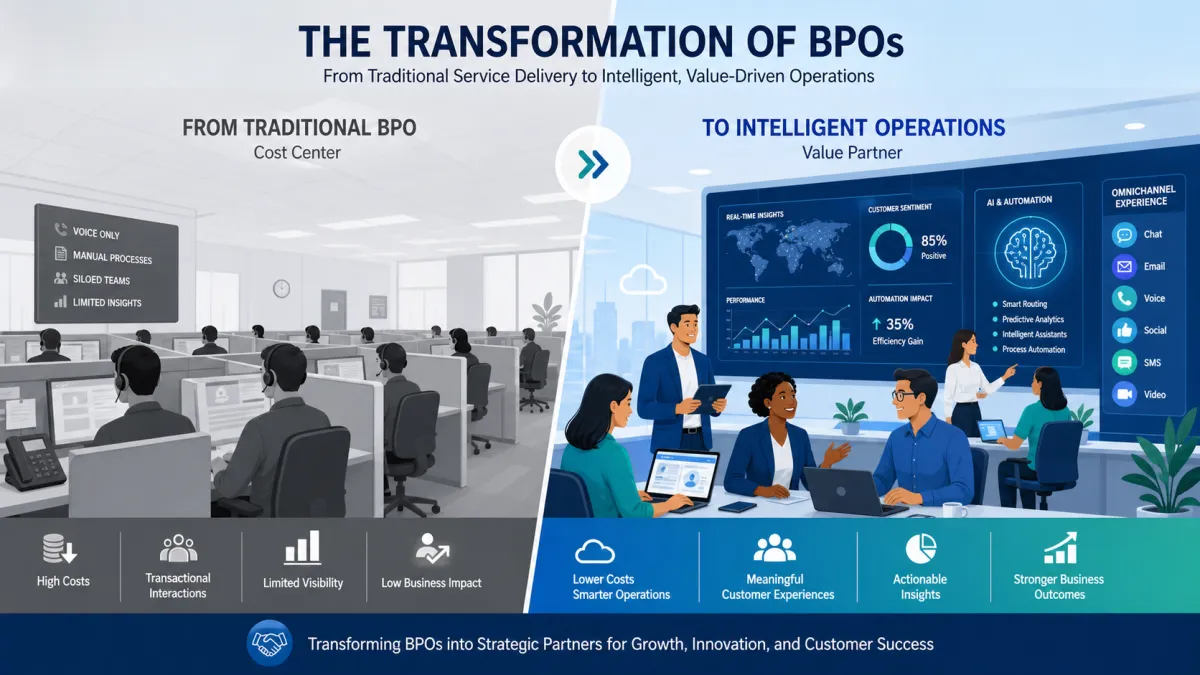
BPO Transformation
BPOs Are No Longer “Butts in Seats”: The Strategic Reinvention of Outsourcing
For decades, the business process outsourcing (BPO) industry was defined by a simple value proposition: provide large volumes of labor at a lower cost. Success was measured in headcount, seat utilization, and cost per call. The model worked—until it didn’t.
Today, that definition is not just outdated—it is a liability.
Enterprises no longer view customer experience, back-office operations, or technical support as isolated cost centers. These functions are now tightly linked to revenue growth, customer retention, and brand perception. As a result, the expectations placed on BPO partners have fundamentally changed. The industry is undergoing a structural transformation from labor arbitrage providers to strategic, technology-enabled partners.
From Labor Arbitrage to Value Creation
The traditional BPO model was built on three pillars: scale, cost efficiency, and process standardization. While those elements still matter, they are no longer sufficient.
Modern enterprises are asking very different questions:
How can this partner improve customer lifetime value?
Can they reduce churn or increase conversion rates?
Do they bring technology and data insights to the table?
Can they flex capacity dynamically without sacrificing quality?
This shift forces BPOs to move beyond transactional service delivery and into outcome-based engagement models. Contracts are increasingly tied to performance metrics such as customer satisfaction (CSAT), net promoter score (NPS), revenue per interaction, and first contact resolution.
The Rise of Tech-Enabled BPO
Technology is the primary catalyst behind this transformation.
Leading BPOs are aggressively investing in:
AI-driven automation for routine interactions
Workforce optimization platforms for real-time staffing adjustments
Advanced analytics for customer behavior insights
Omnichannel engagement capabilities across voice, chat, email, and social
Integration with enterprise CRM and UCaaS ecosystems
In many cases, BPOs are becoming as much technology integrators as they are service providers.
For example, a modern BPO supporting a retail enterprise might deploy AI chatbots to handle tier-1 inquiries, use predictive analytics to identify high-risk churn customers, and route those interactions to highly skilled agents trained in retention strategies. The result is not just lower cost—it is measurable revenue protection.
Talent Is Being Repositioned, Not Replaced
A common misconception is that automation will eliminate the need for human agents. In reality, it is redefining their role.
As low-complexity interactions are automated, human agents are increasingly focused on:
Complex problem resolution
High-value sales interactions
Customer retention and relationship management
Technical support requiring critical thinking
This shift requires a more skilled workforce, better training programs, and tighter alignment with business outcomes. BPOs that invest in talent development are seeing higher productivity per agent and improved client satisfaction.
The Blurring Line Between BPO, UCaaS, and CX Platforms
Another major trend is the convergence of BPO services with unified communications and customer experience technologies.
Enterprises are no longer buying these capabilities in isolation. They expect:
Seamless integration between contact center platforms and service delivery
Real-time visibility into performance metrics
Scalable, cloud-based infrastructure
Rapid deployment across geographies
This creates a competitive advantage for BPOs that can bundle services with technology—or partner effectively with UCaaS and CCaaS providers.
For enterprise buyers, the conversation is shifting from “Who can staff this function?” to “Who can own and optimize this outcome?”
Outcome-Based Partnerships Are the New Standard
The most significant shift is in how BPO relationships are structured.
Traditional pricing models based on FTEs and hours are giving way to:
Transaction-based pricing
Outcome-based SLAs
Gain-sharing agreements tied to business results
This aligns incentives between the enterprise and the BPO provider, turning the relationship into a partnership rather than a vendor contract.
For example, a BPO supporting a financial services firm might be compensated based on successful loan processing rates or customer onboarding speed, rather than the number of agents deployed.
What This Means for Enterprise Buyers
For decision-makers in IT, operations, and customer experience, this transformation changes how BPOs should be evaluated.
Key considerations now include:
Technology stack and integration capabilities
Data analytics maturity
Industry-specific expertise
Ability to deliver measurable business outcomes
Flexibility in commercial models
The lowest-cost provider is rarely the best choice in this new environment. The focus has shifted to total value delivered.
The Bottom Line
The “butts in seats” era of BPO is over.
What remains is a more sophisticated, more strategic industry—one that sits at the intersection of technology, data, and human expertise. The BPOs that succeed in this new landscape will be those that embrace innovation, align with client outcomes, and position themselves as true partners in business transformation.
For enterprises, the opportunity is equally significant: the right BPO relationship can now drive not just efficiency, but competitive advantage.

Menu
Services
© Copyright 2023. Optimal Outcomes. All rights reserved.