Tel: 650-980-4870

Blog
Small Contact Centers - Yes You Can
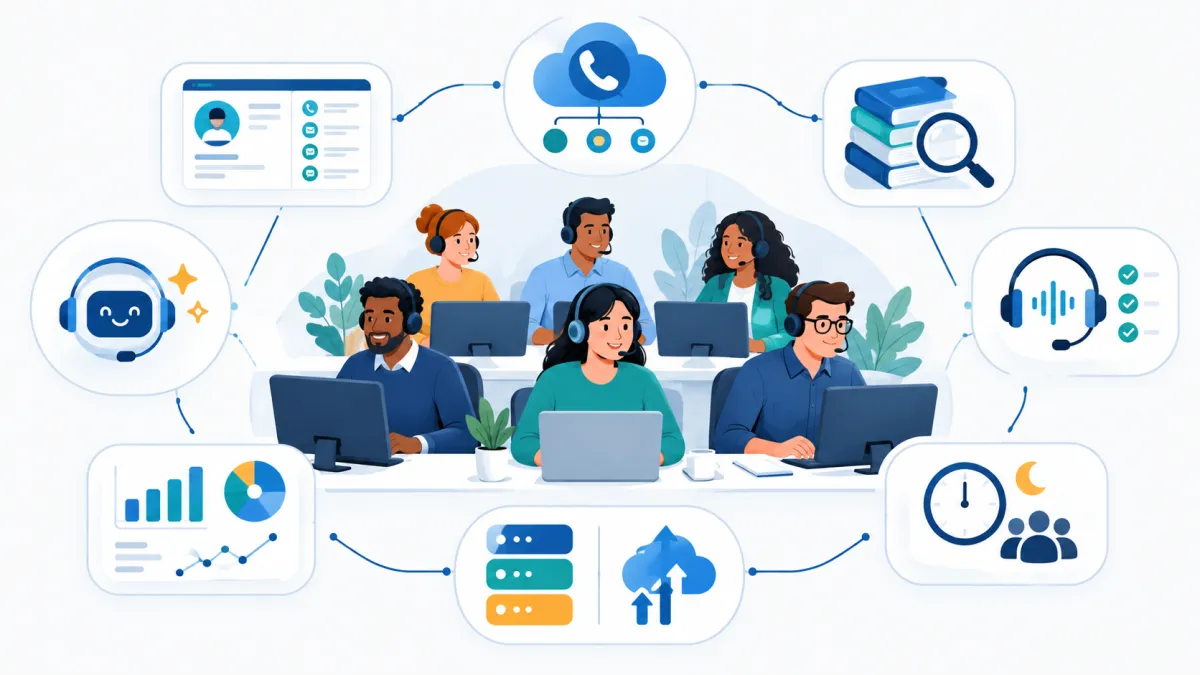
Small call centers can get meaningful gains from technology without buying an “enterprise contact-center stack.” The winning approach is to use cloud, subscription-based tools; automate only high-volume repetitive work; and add specialist services only where internal coverage is thin.
For a center with fewer than 10 agents, focus first on reducing customer effort, agent after-call work, missed calls, and supervisor overhead—not on deploying every available channel or AI feature.
Build a lean core stack
A small operation typically needs five capabilities, preferably through as few vendors as practical:
Capability | Minimum viable function | Affordable approach |
|---|---|---|
Cloud voice/contact center | Business numbers, queues, skills/routing, voicemail, IVR, overflow | Use a cloud platform with flexible per-user or usage-based pricing; avoid PBX hardware and professional-services-heavy deployments. |
Agent workspace | Caller context, dispositioning, notes, CRM case/contact creation | Use the CRM already owned, or start with a lightweight CRM/help-desk integration rather than a separate agent desktop. |
Knowledge base | Searchable answers, policies, scripts, escalation paths | Begin with a well-governed shared knowledge base—not a costly AI knowledge platform. Assign one owner and review it monthly. |
Quality and coaching | Recording, simple evaluation form, coaching notes | Record calls, score a manageable sample, and use findings in weekly coaching. |
Reporting | Calls offered/answered, abandonment, service level, handle time, wrap-up, outcomes | Use the platform’s native dashboard and export data monthly. Do not buy standalone BI until native reporting is demonstrably insufficient. |
Rule of thumb:buy the lowest-cost platform that reliably delivers queues, routing, recording, reporting, CRM connectivity, secure remote-agent support, and an API or integration option. Validate total cost—not simply the advertised starting price—including calling, implementation, storage, transcription, support, and minimum-seat commitments.
Apply technology to the right work
For a sub-10-agent team, a few targeted automations usually produce more ROI than a broad transformation program.
Implement a concise IVR and intelligent routing.Give callers three to five clear choices, route by reason for contact or customer type, and avoid long menus. Offer callbacks during peaks so customers do not remain on hold.
Deflect simple contacts through self-service.Put answers to the top 10 contact reasons on the website, in SMS/email confirmations, and in the IVR. Examples include order status, appointment changes, billing-copy requests, password resets, directions, and policy questions.
Automate post-call administration.Use dispositions, templates, CRM fields, wrap-up automation, and integrations to reduce manual notes and duplicate entry. This is often a better first AI use case than customer-facing automation.
Use AI as an agent assistant before using it as an autonomous agent.Start with transcription, call summaries, suggested dispositions, knowledge retrieval, sentiment/topic tagging, and coaching highlights. Keep human review for compliance-sensitive, financial, medical, legal, customer-retention, or exception decisions.
Create an overflow path.Rather than staffing for the highest peak, establish threshold-based overflow through an answering service, BPO partner, trained internal staff, or scheduled callback team.
Use services selectively
Small centers do not need to build every specialty internally. A practical model is a fractional-services layer around a lean internal team.
Need | Affordable service model | When it makes sense |
|---|---|---|
After-hours or peak coverage | Shared answering service or overflow BPO | Demand is volatile or calls arrive outside normal business hours |
Quality assurance | Fractional QA analyst or managed QA sampling | No supervisor has enough time or calibration discipline |
Workforce planning | Light forecasting and schedule support | Peaks cause abandonment, overtime, or uneven workloads |
Training | Microlearning, peer coaching, targeted external modules | New hires or recurring performance gaps |
CRM/contact-center integration | Fixed-scope implementation partner | The team needs one integration, not an open-ended transformation program |
Security/compliance | Managed IT/security review or industry-specific advisor | Payments, regulated information, or customer data exposure creates material risk |
Purchase clearly bounded outcomes: “score 20 calls per agent per month,” “cover weekday evenings,” or “build a CRM screen-pop and disposition sync.” Avoid vague retained services without defined volume, service levels, deliverables, and exit terms.
Run a practical operating model
Technology alone will not make a very small center efficient. Small teams need simple, consistent operating disciplines.
Measure a small KPI set.Start with answer rate, abandonment rate, service level, average speed of answer, first-contact resolution, transfer/escalation rate, quality score, schedule adherence, and the business result that matters most—appointments set, revenue retained, cases resolved, collections, or customer satisfaction.
Review contact reasons monthly.Identify the top five avoidable drivers. If “where is my order?” represents a large share of calls, improve proactive shipping notifications before adding agent capacity.
Cross-train every agent.In a team of six, one absence removes a major portion of capacity. Train agents across at least two contact types and publish clear escalation rules.
Keep QA lightweight but regular.Review a small number of calls per agent each week using a short scorecard: verification/compliance, issue diagnosis, accuracy, empathy/communication, documentation, and next step.
Design for remote resilience.Standardize headsets, connectivity requirements, MFA, secure device policies, and an outage procedure. A flexible remote or hybrid model can lower facility costs and broaden the hiring pool.
Use a 90-day adoption plan.Deploy core voice, routing, and recording first; then CRM/knowledge and reporting; then one automation or AI-assist use case.
Avoid common cost traps
Paying for a full omnichannel suite when nearly all demand is voice and email.
Buying AI licenses for every user before validating a specific, measurable use case.
Locking into long contracts with high seat minimums or unclear implementation fees.
Buying standalone WFM, QA, analytics, chatbot, CRM, and telephony products before exhausting bundled capabilities.
Customizing every workflow instead of using standard configurations.
Treating call recording as a QA program without scorecards, calibration, and coaching.
Automating complex, emotional, compliance-sensitive, or revenue-risk conversations.
Ignoring carrier usage, toll-free, international, SMS, storage, transcription, integration, and support charges in the total-cost model.
A sensible starter blueprint
For a 5–8-agent center, a strong low-cost design would be:
Cloud contact-center or UCaaS service with voice queues, IVR, callback, recording, supervisor visibility, and native reporting.
Existing CRM or help desk connected for screen pop, contact history, dispositions, and case creation.
Shared knowledge base organized around the top contact reasons.
Basic remote-agent security and standardized USB or wired headsets.
Weekly QA and coaching using recorded calls and a six-criteria scorecard.
Monthly contact-driver analysis and one improvement initiative at a time.
AI limited initially to transcription, summaries, agent knowledge assistance, and post-call documentation.
Flexible overflow coverage only for defined peak periods, after-hours, or outage contingencies.
The objective is not to make a 10-person center look like a 1,000-seat operation. It is to make each agent more prepared, reduce unnecessary contacts and manual work, preserve service during peaks, and give management clear operational visibility with predictable monthly cost.

Menu
Services
© Copyright 2023. Optimal Outcomes. All rights reserved.