Tel: 650-980-4870

Blog
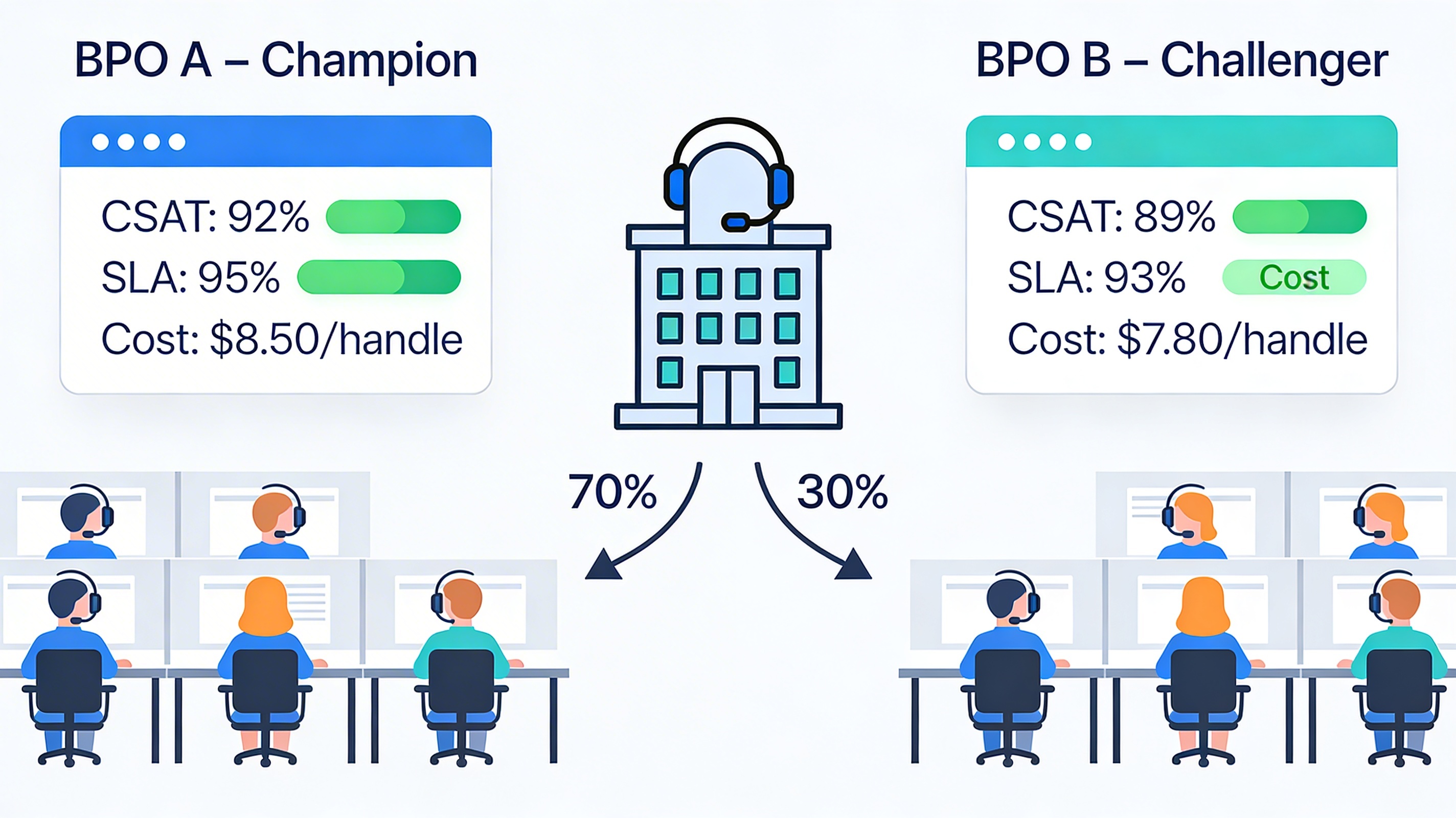
Champion - Challenger
A champion–challenger scenario in contact centers is a structured way to manage two or more BPO partners by putting them in controlled competition under a common scorecard. The “champion” is the incumbent or top‑performing BPO that holds most of the volume, while one or more “challengers” handle a smaller share and can win additional volume by delivering better results.
What the setup looks like
In practice, you split your contact volume (voice, chat, email, etc.) between the champion and the challenger(s), using the same KPIs, processes, and brand standards. You then compare performance head‑to‑head and shift volume over time toward whoever proves most effective. The challenger often becomes the place to test new ideas—technology, scripts, or training—before scaling them more broadly.
Key benefits
1. Stronger performance and continuous improvement
Competition keeps the champion from getting complacent and motivates challengers to over‑deliver.
Both partners have clear incentives to improve SLAs, CSAT/NPS, FCR, and efficiency.
The model naturally surfaces what “good” really looks like for your brand, because you see multiple ways of solving the same problems.
2. Lower risk and more resilience
You avoid single‑vendor dependency; if one BPO struggles, you can flex more volume to the other.
Geographic and operational risk is spread across multiple locations and operating models.
It becomes easier to manage spikes, outages, or unexpected events because you already have an active alternate partner.
3. Built‑in innovation engine
The challenger can serve as a sandbox for new tech (AI, bots, QA tools), processes, or staffing models.
Successful experiments can be standardized and rolled out to the champion as well.
Over time, you get a faster innovation cycle without putting your entire operation at risk.
4. Better commercial leverage
Multiple partners give you stronger negotiating power on price and terms.
You can tie volume shares to performance, creating a meaningful incentive rather than relying only on penalties.
Vendors are more willing to co‑invest in improvements when there is a clear path to earning more business.
5. More robust, data‑driven decisions
Having two or more BPOs working the same or similar work types forces you to define consistent metrics and QA.
You get richer comparative data: by site, region, vendor, and even playbook.
This supports more objective decisions about who gets what work and where to double down.
Potential downsides and risks
1. Increased management overhead
Multi‑vendor ecosystems are harder to run: governance, QBRs, reporting, and change management all multiply.
You have to maintain consistent processes, knowledge bases, and training across partners.
Without enough internal capacity, the complexity can negate the benefits.
2. Risk of “gaming” the metrics
In a competitive model, vendors may optimize to the scorecard instead of the customer.
Examples: shortening calls to reduce handle time at the expense of true resolution, or nudging customers toward channels that look better on paper.
You need a balanced scorecard and strong QA to ensure behaviors align with actual customer outcomes.
3. Inconsistent customer experience
Different BPOs bring different cultures, coaching styles, and leadership, which can show up in tone and quality.
Customers might feel they get a different standard of service depending on who answers.
This requires tight brand guidelines, shared knowledge, and aligned QA rubrics to keep the experience cohesive.
4. Inter‑partner friction
Competition can turn toxic if one BPO hoards information, resists collaboration, or blames the other for issues.
If you’re not transparent about how you score and allocate volume, trust erodes quickly.
You need clear rules of engagement, shared forums, and a culture that rewards collaboration as well as performance.
5. Shallow pilots and “challenger fatigue”
If the challenger never gets enough volume, time, or support, they can’t truly prove their capabilities.
Under‑resourced pilots lead to weak comparisons and can discourage serious investment from the challenger.
The model works best when you commit to real test volumes, clear success criteria, and defined review points.
Designing a champion–challenger model that works
To get the upside without drowning in complexity, it helps to:
Define a clear, balanced scorecard (operations, quality, CX, and business outcomes).
Bake volume‑mobility into contracts so you can shift share based on performance.
Standardize knowledge, brand guidelines, and QA across all BPOs.
Use centralized reporting and QA so everyone is working from the same data.
Position the model as a continuous‑improvement engine, not a one‑time “winner‑takes‑all” bake‑off.
When this model makes sense
Champion–challenger is especially valuable when you:
Have enough volume and complexity to justify multiple partners.
Want to de‑risk a single‑vendor setup.
Need a structured way to test new technologies or locations.
Care about continuous optimization of CX, not just cost take‑out.
For smaller programs or teams with limited governance bandwidth, a simpler single‑vendor or cooperative multi‑vendor model may be more practical.

Menu
Services
© Copyright 2023. Optimal Outcomes. All rights reserved.