Tel: 650-980-4870

Blog
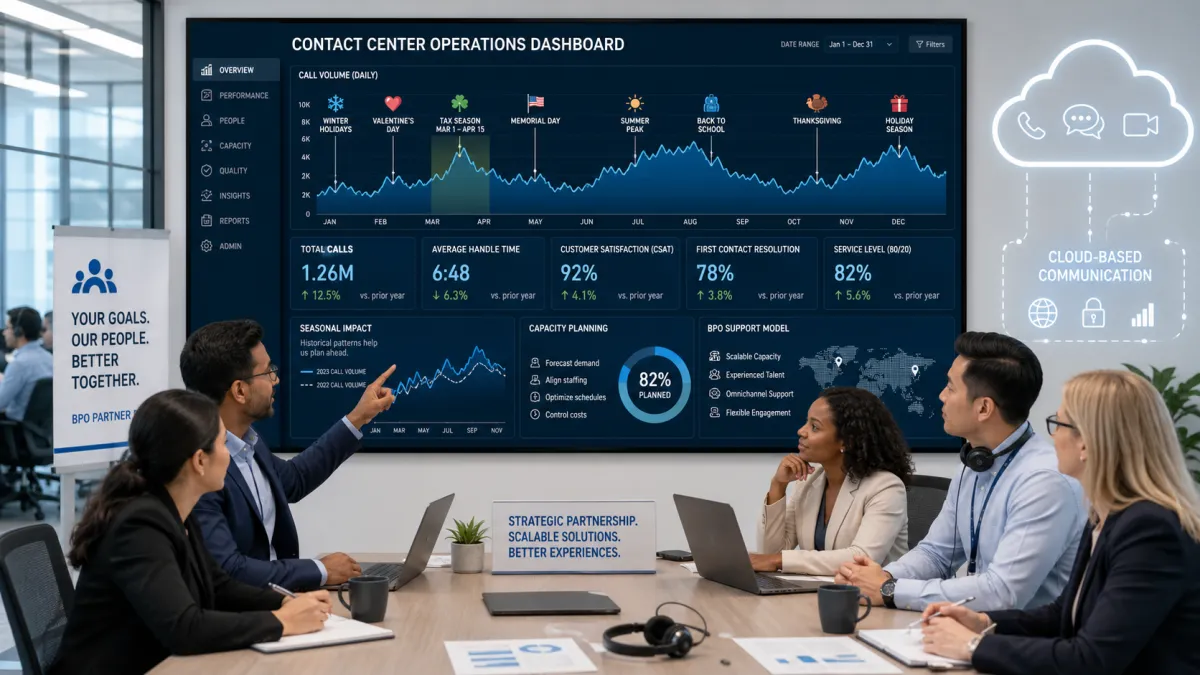
Seasonality in Contact Centers
Managing Seasonality in Contact Centers: Challenges, Strategies, and the Role of BPOs
Seasonality is a defining force in contact center operations. From retail holiday surges to tax season spikes and healthcare enrollment periods, demand can fluctuate dramatically within short timeframes. For organizations focused on delivering consistent customer experience while controlling costs, managing these fluctuations is both a strategic and operational challenge.
The Nature of Seasonality
Seasonality in contact centers typically manifests as predictable spikes tied to industry cycles, marketing campaigns, or external events. Common examples include:
Retail: Holiday shopping and returns periods
Financial services: Tax season and year-end planning
Travel and hospitality: Peak vacation periods and disruptions
Healthcare: Open enrollment windows
While these patterns are often forecastable, their intensity and variability can still strain resources.
Key Challenges
Seasonal demand introduces several operational hurdles:
Workforce volatility: Hiring, training, and ramping temporary agents quickly without sacrificing quality
Forecasting accuracy: Even small forecasting errors can lead to long wait times or overstaffing costs
Customer experience risk: Increased volumes often correlate with longer handle times and reduced satisfaction
Technology strain: Systems must scale to handle spikes in voice, chat, and digital interactions
Cost management: Balancing service levels with the financial impact of temporary staffing and overtime
For many organizations, these challenges expose the limitations of rigid, in-house operating models.
Strategies to Address Seasonality
Forward-looking contact centers deploy a mix of operational and technological strategies:
Advanced forecasting and WFM tools: Leveraging AI-driven analytics to predict demand patterns more accurately
Flexible staffing models: Using part-time, gig, or cross-trained employees to scale capacity
Digital deflection: Expanding self-service options such as chatbots, IVR automation, and knowledge bases
Omnichannel optimization: Shifting volume from high-cost channels (voice) to lower-cost digital channels
Cloud-based infrastructure: Enabling rapid scalability without heavy capital investment
These approaches help smooth demand curves, but they often need to be supplemented with external support.
The Role of BPOs in Seasonal Scaling
Business Process Outsourcing (BPO) providers play a critical role in helping organizations manage seasonal fluctuations effectively.
Rapid scalability: BPOs maintain large, trained agent pools that can be deployed quickly
Global delivery models: Follow-the-sun support and geographic diversity help manage peak loads
Specialized expertise: Many BPOs bring industry-specific knowledge and optimized processes
Cost flexibility: Shifting from fixed to variable cost structures aligns expenses with demand
Technology integration: Leading BPOs integrate seamlessly with client UCaaS and CCaaS platforms
For example, a retail organization preparing for holiday season may offload Tier 1 inquiries (order status, returns) to a BPO, while retaining higher-value interactions in-house. This hybrid model preserves customer experience while improving cost efficiency.
Emerging Trends
Several trends are reshaping how contact centers handle seasonality:
AI-augmented agents: Reducing training time and improving performance of seasonal staff
On-demand workforce platforms: “Gig CX” models enabling near real-time staffing adjustments
Proactive customer engagement: Using outbound notifications to reduce inbound spikes
Deeper BPO partnerships: Moving from transactional outsourcing to strategic, integrated delivery models
These innovations are helping organizations move from reactive to proactive seasonality management.
Final Thoughts
Seasonality is unavoidable, but it does not have to be disruptive. Organizations that combine intelligent forecasting, flexible operating models, and strategic use of BPO partners can turn seasonal volatility into a competitive advantage. The key lies in designing a contact center ecosystem that is not only scalable, but also resilient and customer-centric.

Menu
Services
© Copyright 2023. Optimal Outcomes. All rights reserved.