Tel: 650-980-4870

Blog
Tech Enabled BPO
What Is a Tech-Enabled BPO? Understanding the Spectrum
The term “tech-enabled BPO” gets used frequently in customer experience and outsourcing conversations, but it often means very different things depending on who is using it. For buyers, this ambiguity can create confusion when evaluating vendors. For providers, it creates an opportunity to differentiate—or to overstate capabilities.
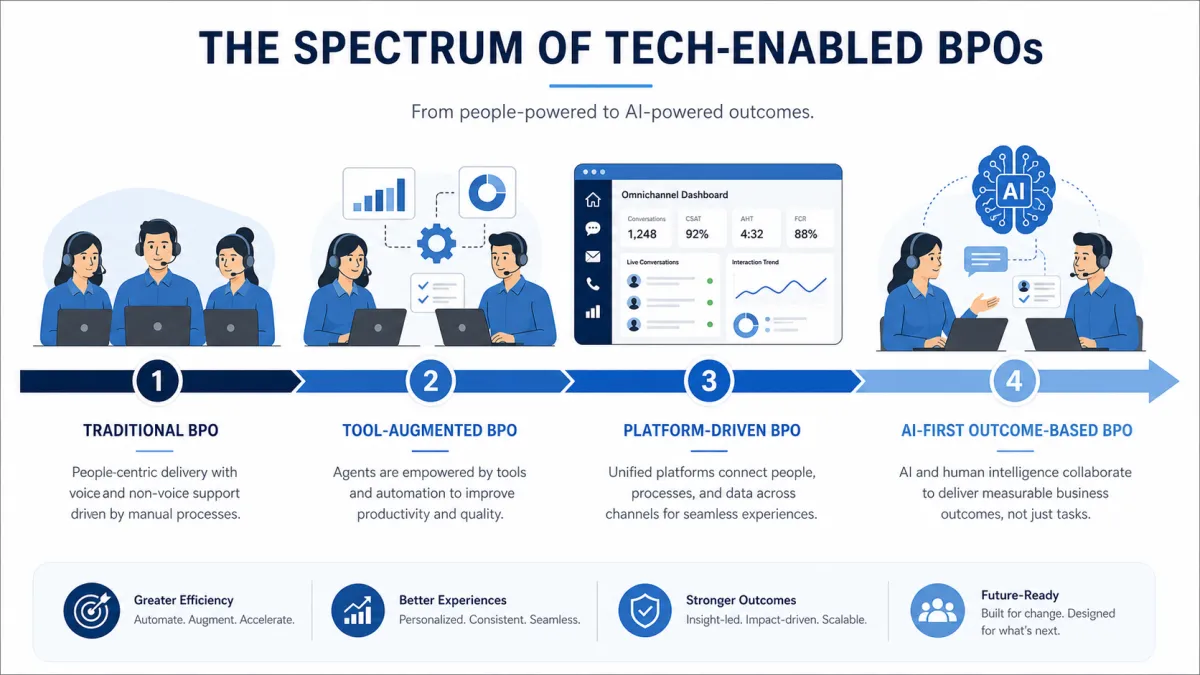
At its core, a tech-enabled BPO is not just about outsourcing labor. It is about combining human operations with technology, data, and automation to deliver better outcomes, not just lower costs. The key is understanding that this exists on a spectrum, not as a binary label.
The Traditional Baseline: Labor-Centric BPO
At one end of the spectrum sits the traditional BPO model. These providers deliver value primarily through labor arbitrage, process standardization, and scale.
Technology exists in this model, but it is typically:
Client-owned or client-mandated
Used for basic functions like ticketing, CRM access, or telephony
Not a source of differentiation
In this scenario, the BPO is an operator, not an innovator. Outcomes are measured in terms of cost per contact, SLA adherence, and headcount efficiency.
The Emerging Layer: Tool-Augmented BPO
Moving along the spectrum, many BPOs have invested in proprietary tools or partnerships that enhance delivery.
These capabilities often include:
Workforce management optimization
Basic analytics and reporting dashboards
QA automation and speech analytics
RPA for back-office processes
Here, technology starts to improve efficiency and visibility. However, it is often layered on top of existing processes rather than fundamentally transforming them.
This is where many providers position themselves as “tech-enabled,” though the impact is typically incremental rather than transformational.
The Integrated Model: Platform-Driven BPO
Further along the spectrum are BPOs that integrate technology deeply into their operating model. These organizations treat technology as a core component of service delivery, not an add-on.
Characteristics include:
Proprietary or tightly integrated CX platforms
Omnichannel orchestration across voice, chat, messaging, and email
Real-time analytics driving agent behavior and customer journeys
AI-assisted agents (co-pilots, knowledge surfacing, next-best action)
In this model, the BPO begins to influence not just execution, but experience design. They can actively shape customer journeys, reduce friction, and improve outcomes like CSAT, containment, and revenue per interaction.
The Leading Edge: Outcome-Based, AI-First BPO
At the far end of the spectrum are providers that are redefining what BPO means entirely. These organizations are built around automation, AI, and continuous optimization.
Key attributes include:
AI-driven self-service and containment strategies
End-to-end journey ownership, not just channel support
Commercial models tied to outcomes (e.g., revenue, retention, resolution rates)
Continuous data feedback loops to refine processes and models
Here, human agents are still critical, but they are deployed more strategically—handling exceptions, high-value interactions, and complex problem-solving.
The BPO becomes less of a vendor and more of a transformation partner.
Why the Spectrum Matters for Buyers
Understanding this spectrum is critical when evaluating providers, especially in a market where nearly every BPO claims to be “tech-enabled.”
Key questions to ask:
Is the technology proprietary, partnered, or client-provided?
Does the tech change outcomes or just improve reporting?
How deeply is technology embedded in daily operations?
Are commercial models aligned to business results or just activity?
Without these distinctions, it is easy to overpay for marginal improvements or miss opportunities for real transformation.
The Strategic Takeaway
“Tech-enabled BPO” is not a category—it is a maturity curve.
Most providers sit somewhere in the middle, blending labor, tools, and selective automation. The real differentiation lies in how tightly technology is integrated into the operating model and whether it drives measurable business outcomes.
For organizations navigating digital transformation, the goal should not be to find a vendor that uses technology. It should be to find a partner that uses technology to fundamentally change the economics and experience of customer engagement.

Menu
Services
© Copyright 2023. Optimal Outcomes. All rights reserved.