Tel: 650-980-4870

Blog
Agentic AI in the Contact Center
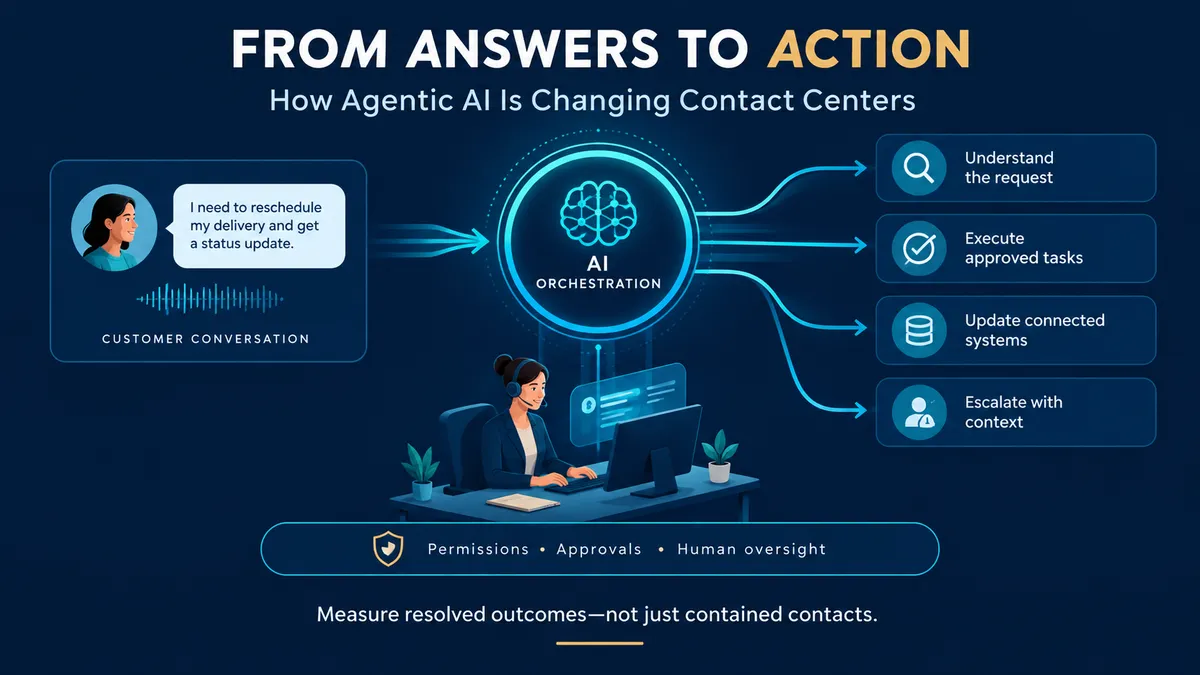
Agentic AI is moving contact centers from answering questions to completing work. Instead of simply explaining a refund policy or suggesting what an agent should do, it can look up the transaction, check eligibility, execute an approved action, update the case, and escalate exceptions. The key shift is execution—within defined permissions, not unlimited autonomy.
How it’s changing the operation
1. Self-service can resolve an issue—not just provide information
Traditional bots often stop at an answer, a link, or a transfer. Agentic systems can connect the conversation to business systems and carry out multistep tasks. Examples include processing a return, changing an appointment, checking an order, or updating a customer record. Those capabilities depend on the integrations and permissions actually deployed.
For example, a customer saying, “My replacement never arrived,” could trigger a workflow that checks shipment status, determines the permitted remedy, arranges the next action, and records the outcome—all within the same interaction. That illustrates the difference between conversational assistance and task execution.
2. Agent assist is becoming more action-oriented
Existing agent-assist tools retrieve knowledge, recommend next steps, and produce summaries and dispositions. Connecting those capabilities to authorized workflows lets AI do more of the administrative work while the employee retains control over consequential decisions.
The distinction is between “Here’s what to do” and “Here’s the prepared action for you to approve.” For contact-center leaders, that expands the opportunity beyond shorter conversations to less application switching and less after-call work.
3. Human agents increasingly handle exceptions and judgment
Agentic service systems are designed to resolve common requests and route complex or sensitive situations to people. That changes the human role toward resolving ambiguity, handling exceptions, and managing relationships—not simply processing the next routine transaction.
It also makes the handoff critical. The receiving employee needs the customer’s intent, relevant history, and what the AI has already attempted—not merely a transfer and a transcript. Otherwise, automation creates another place where customers must repeat themselves.
4. Front-office conversations connect more directly to back-office work
The larger change is not a more conversational IVR. It is the ability to move from a customer request into a connected workflow: retrieve information, apply rules, trigger an action, and route an exception across systems.
That makes process design and system integration central to the business case. A capable conversational interface cannot, by itself, complete work in systems it cannot access or is not authorized to change.
What leaders should measure differently
Evaluate agentic AI around completed customer outcomes rather than containment alone. Avoiding a human handoff does not necessarily mean the customer’s issue was resolved.
A practical scorecard would include:
Measure | What it helps establish |
|---|
Measure | What it helps establish |
|---|---|
Verified resolution | Did the requested task actually get completed? |
Repeat contact | Did the customer return because the issue remained unresolved? |
End-to-end resolution time | Did AI shorten the whole process, not just the conversation? |
Cost per resolved issue | Did savings survive integration, oversight, and exception costs? |
Handoff quality | Could the employee continue without restarting discovery? |
Action accuracy and compliance | Did the system take the right action within its authority? |
These are proposed evaluation criteria—not a claim that every deployment already delivers improvements.
The biggest constraint: trust and control
An incorrect answer is a problem; an incorrect account change or financial transaction can be more consequential. Agentic systems therefore need explicit action limits, appropriate approvals, monitoring, and clear escalation paths.
A practical starting point is a bounded, high-volume workflow whose outcome is easy to verify—such as appointment changes or order-status follow-up. Expand authority only after testing completion accuracy, exceptions, and handoffs.
For a CX transformation discussion, the useful question is no longer just, “How many contacts can AI handle?” It is, “How much customer work can it safely finish—and how well does it collaborate with people when it cannot?”

Menu
Services
© Copyright 2023. Optimal Outcomes. All rights reserved.