Tel: 650-980-4870

Blog
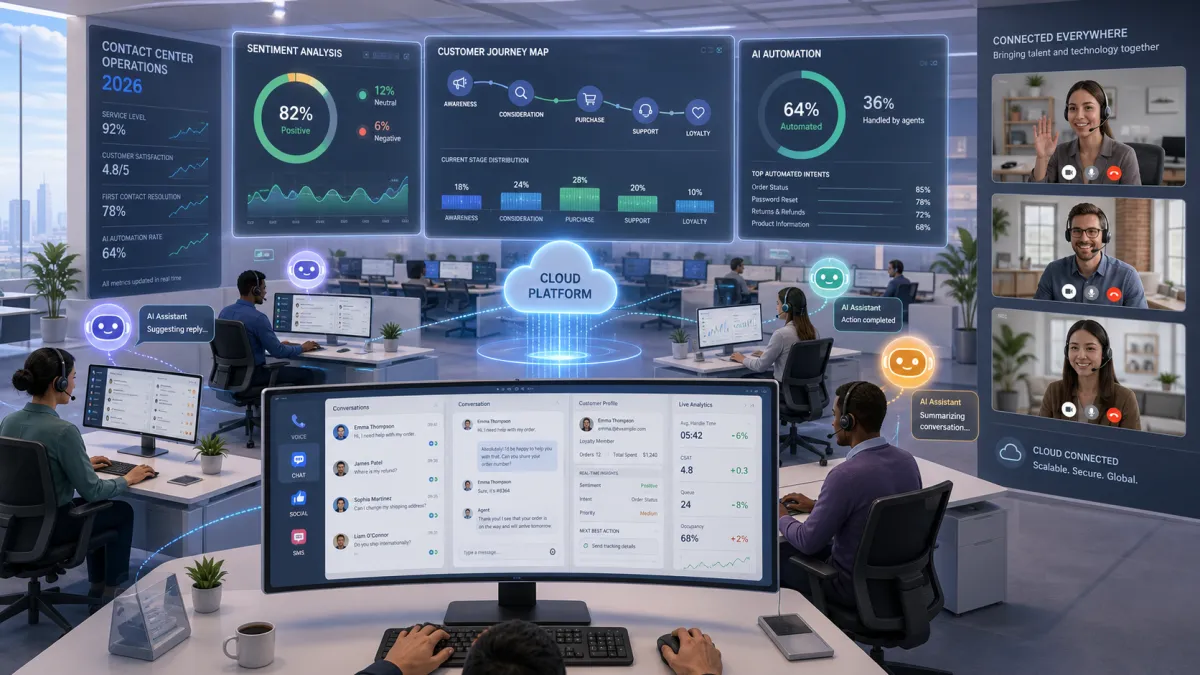
Contact Center - 2 Years from Now
Two years from now, contact centers will be AI‑first, cloud‑native “experience hubs” where autonomous digital agents handle most routine interactions and human agents focus on complex, emotional, and high‑value conversations.
Big shift: AI front doors and digital “teams”
By 2028, at least 70% of customers are expected to begin their journey with conversational AI, not a human or an IVR tree. Over the next two years, that means most contact centers will have always‑on voice and chat agents that can understand natural language, resolve multi‑step issues, and trigger back‑office workflows on their own.
These AI agents will sit across all channels and act like a digital front door: they’ll authenticate customers, pull context from CRM and past interactions, and either fully resolve the issue or warm‑transfer to a human “super agent” with a concise summary and recommended next steps. Instead of static bots, you’ll see self‑improving systems that continuously learn from every interaction to refine responses and routing logic.
Omnichannel as the default fabric
Omnichannel will no longer be a project; it will be the standard operating model. Cloud contact center platforms will unify voice, email, web chat, messaging apps, social, and SMS into a single interaction stream so customers can move between channels without losing context.
Supervisors and agents will work from a single desktop where they see the entire customer journey, regardless of channel, along with real‑time AI insights about intent, sentiment, and next best action. This unified fabric also enables smarter, skills‑based and intent‑based routing that finds the “perfect match” between customer and agent, taking into account availability, expertise, and predicted outcomes.
Agents become “super agents”
As automation absorbs repetitive work, the human role will shift toward complex problem‑solving, relationship management, and sales. Agents will be supported by real‑time AI copilots that listen to calls and chats, summarize context, surface knowledge, and suggest responses as conversations unfold.
This AI‑first assist model will reduce handling time and after‑call work by automatically drafting case notes, updating records, and creating follow‑up tasks. Training will also change: new hires will ramp faster with AI‑driven coaching, scenario simulations, and personalized learning paths based on actual interaction data.
Operating model: distributed, cloud, and data‑driven
Cloud‑based CCaaS will be nearly universal in new deployments, giving leaders agility to spin up remote or regional “micro‑sites” and specialized teams quickly. Remote and hybrid work, already mainstream, will be supported by AI‑enhanced workforce management that predicts demand, optimizes schedules, and dynamically re-allocates capacity across channels and locations.
Operational decisions will be driven by cleaner, connected data across CRM, ticketing, billing, and experience platforms. Leaders will rely on real‑time analytics to monitor sentiment, effort, first‑contact resolution, and revenue impact, with AI flagging anomalies and recommending actions rather than teams manually pulling reports.
Self‑service, security, and hyper‑personalization
Self‑service will become an expectation, not a deflection tactic. Customers will navigate rich FAQ portals, interactive troubleshooters, and AI assistants that are tightly integrated with back‑office systems so they can actually complete tasks, not just answer questions.
At the same time, security will tighten with voice biometrics and continuous authentication embedded into IVR and AI flows to reduce friction while cutting fraud. Hyper‑personalization will emerge as a differentiator, as AI uses real‑time and historical data to tailor offers, prioritize queues for high‑value or at‑risk customers, and adapt tone and responses to individual preferences.

Menu
Services
© Copyright 2023. Optimal Outcomes. All rights reserved.