Tel: 650-980-4870

Blog
CX Trends
The CX Trends Redefining Contact Centers in 2026
Customer experience leaders came into 2026 with big promises to keep: deliver more with less, prove AI ROI, and stop burning out frontline teams. This is the year those promises either turn into operating reality—or get exposed as slideware.
Across the market, the pattern is clear: cloud is now the baseline, AI is embedded in live journeys, and clean data plus strong governance separate the leaders from everyone else.
Trend 1: AI Moves From Pilots To The Core
The biggest CX story inside contact centers this year is not “we’re testing AI” but “AI now runs inside our day-to-day workflows.”
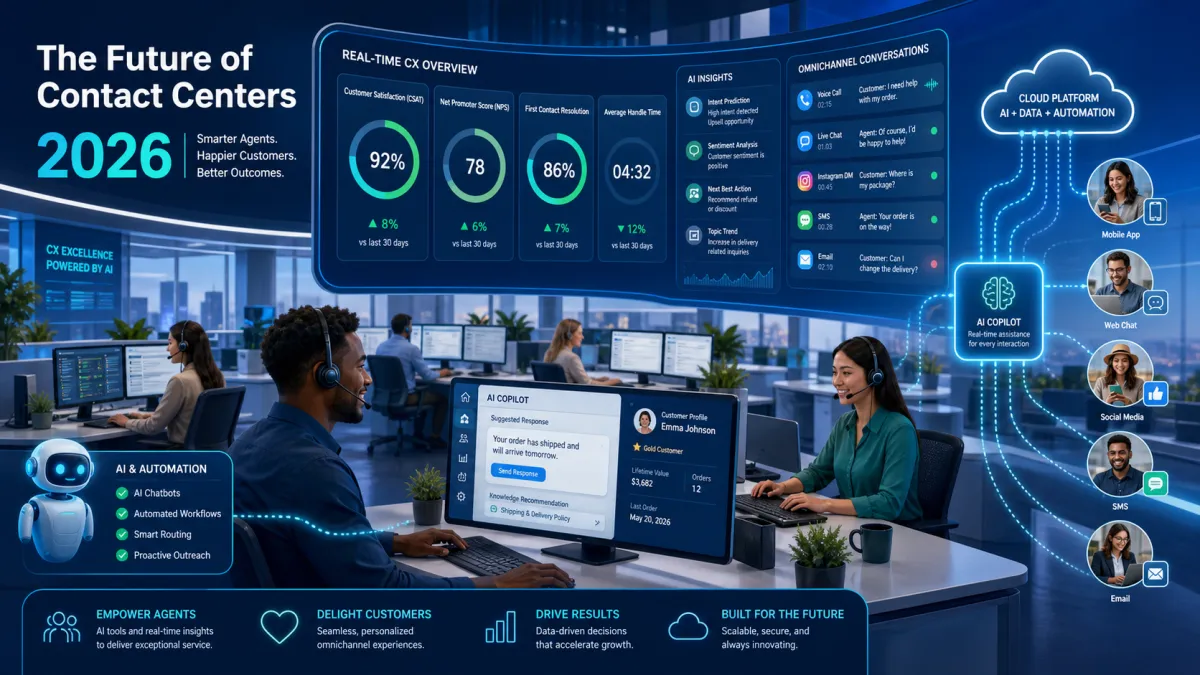
A growing share of interactions are now fully or partially automated, with AI driving routing decisions, intent detection, next-best-action, and post-call summaries in real time. Agent-assist copilots surface knowledge articles, past interactions, and suggested responses in the moment, cutting handle time while reducing cognitive load on agents.
The mindset shift is important: AI is being treated less as a channel (e.g., “the chatbot”) and more as an always-on capability that underpins the entire contact center—voice, digital, self-service, and back-office processes.
Trend 2: GenAI-Powered Self-Service Grows Up
Self-service is no longer limited to static FAQs and brittle IVR menus. Generative AI and “agentic” virtual agents are handling multi-step, outcome-based journeys: think troubleshooting across channels, subscription changes, or guided returns rather than canned one-liners.
Modern AI chatbots and virtual assistants can execute workflows end-to-end, integrate with CRM and ticketing systems, and understand natural language across voice and digital. Customers, for their part, are increasingly comfortable with bots—especially when speed and 24/7 availability matter more than human empathy.
The strategic nuance in 2026 is that mature CX organizations are reframing automation from “containment” to “recovery”: they use AI to get simple things done fast, then gracefully escalate high-value or emotionally charged moments to humans with full context.
Trend 3: Voice AI Becomes A Front-Door Experience
For years, AI innovation lived mostly in chat. In 2026, voice AI is finally catching up—and in many contact centers, it is redefining the phone experience altogether.
Modern voicebots can handle inbound requests in natural, human-sounding language, authenticate callers, capture intent, and either resolve the issue or route to the best-fit agent with rich metadata. When connected to CRM and knowledge systems, voice AI becomes an orchestration layer rather than just an IVR replacement—shortening queues, reducing transfers, and elevating agents to the conversations where they add the most value.
Trend 4: CCaaS Is The Foundation, Not The Finish Line
The migration story has changed. In 2026, the conversation is less “should we move off our legacy platform?” and more “how do we architect our cloud contact center to fully exploit AI and real-time data?”
Cloud-native CCaaS platforms now offer the agility to release new capabilities quickly, integrate channels more easily, and provide the elasticity needed for AI-heavy workloads. They are seen as the foundation on which AI, automation, analytics, and security are layered.
That said, hybrid remains the reality for many verticals with strict compliance needs. Organizations blend cloud innovation with on-prem components, but the focus is firmly on consolidating fragmented systems and vendors to reduce risk and unlock end-to-end insight.
Trend 5: Clean, Connected Data As A CX Superpower
AI is only as good as the data it learns from—and this year, “clean, connected data” has moved from a technical aspiration to a CX board priority.
Unified data models across channels, systems, and journeys are emerging as a key differentiator. The leaders are investing in centralized data layers that break down silos between CRM, CCaaS, WFM, QA, and marketing; governance frameworks to ensure data quality and access control; and real-time conversation intelligence that turns transcripts and interaction metadata into actionable insight.
This “data-first” discipline directly impacts CX metrics: better routing, more accurate personalization, and faster feedback loops on what is actually driving customer satisfaction or churn.
Trend 6: AI-Powered QA, WFM, And EX
AI is not just pointed at customers; it is increasingly pointed at the employee experience inside the contact center.
AI-driven quality assurance tools can now auto-score most or all interactions for adherence, sentiment, and outcomes, replacing random sampling and subjective manual reviews. Workforce management is also being reshaped: machine learning models forecast volume more accurately, optimize schedules, and even flag burnout risks based on interaction patterns and sentiment.
This has two big implications: leaders get a much clearer picture of performance, risk, and coaching needs at scale, and agents get fairer evaluations, more tailored coaching, and—in mature programs—more predictable workloads and better work-life balance.
The overarching EX trend is “AI-augmented agents” rather than “AI instead of agents”: technology removes repetitive work and cognitive overhead so humans can focus on complex, emotional, or revenue-critical conversations.
Trend 7: Security, Compliance, And Trust As AI Scales
As contact centers become AI-first, the risk surface expands—and in 2026, security and compliance have become central design constraints for CX leaders, not afterthoughts.
Organizations are tightening governance around how AI models are trained, where data lives, who can access it, and how decisions are explained. Many are embedding compliance directly into workflows, using automated redaction, PCI-compliant payment flows, and policy-aware bots that understand which actions are allowed in which contexts.
This focus on trust is not just about avoiding fines; it is increasingly a brand differentiator. Enterprises that rush AI into production without appropriate safeguards risk customer backlash, regulatory scrutiny, and internal resistance from agents.
Trend 8: Omnichannel Becomes “Channel-Less”
Omnichannel is no longer a slide in a vendor deck; it is becoming a lived expectation. Customers assume they can move fluidly between phone, chat, social, SMS, and even physical touchpoints without repeating themselves.
Modern platforms are converging contact center and CRM capabilities so every interaction—across channels and time—contributes to a persistent, actionable customer profile. Some providers are already pushing beyond omnichannel toward multimodal experiences, where customers can share text, images, and video in a single thread, and AI understands and maintains context across all of it.
The design implication: CX leaders must architect journeys around the customer’s problem, not around internal channels or org charts.
Trend 9: Human-First CX In An AI-First World
As automation expands, a counterbalancing trend is taking hold: “human-first CX.”
Forward-thinking organizations recognize that the most memorable, loyalty-building experiences still happen in human conversations—especially in moments of high emotion, complexity, or value. AI is deployed to free up time and insight so agents can show up as experts, advocates, and problem-solvers, not script-followers.
This shows up in premium, high-touch service tiers for critical customers or use cases, coaching programs fueled by conversation intelligence and real-time feedback, and KPIs that elevate sentiment, effort, and long-term value over raw handle-time reduction.
Put simply, the best CX strategies in 2026 are not “AI vs. humans” but “AI for humans”—customers and agents alike.
What CX Leaders Should Do Next
Pulling these trends together, the path forward for contact center and CX leaders in 2026 looks something like this:
Treat CCaaS as your foundation, not your end goal, and architect for AI, data, and governance from day one.
Start with high-impact AI use cases that blend self-service and agent assist, and measure success beyond containment.
Invest heavily in data quality and connectivity before scaling AI models across the enterprise.
Build security, compliance, and transparency into your CX stack to earn trust from customers and employees.
Put your people at the center: use AI to remove friction from their day, elevate their skills, and reserve them for the moments that matter most.
This is the year contact centers stop talking about the future of CX and actually start operating like it.

Menu
Services
© Copyright 2023. Optimal Outcomes. All rights reserved.