Tel: 650-980-4870

Blog

Contact Center Trending into 2027
The second half of 2026 is shaping up as the move from AI pilots to operational redesign: enterprises are putting AI into voice, agent workflows, QA, routing, and self-service—but are being forced to prove resolution quality, integration depth, and governance. In 2027, the center of gravity should shift toward orchestrated, multi-agent workflows and a deliberately hybrid human–AI operating model.
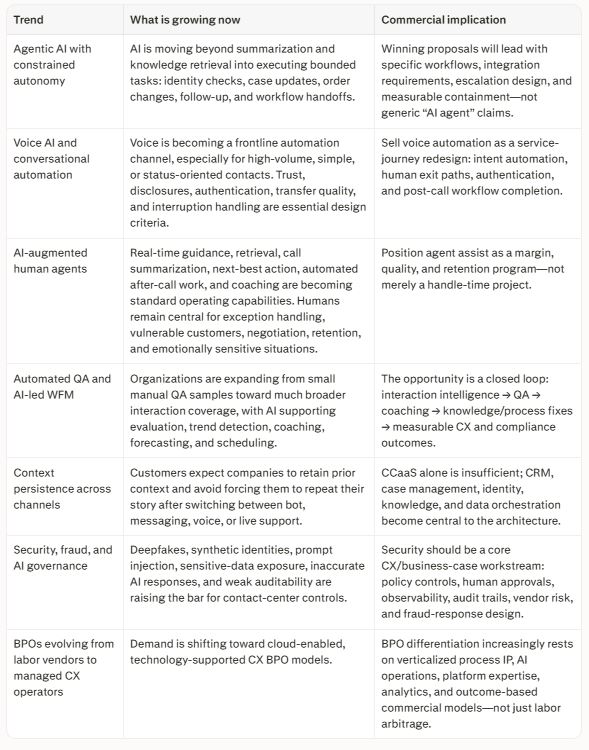
Trends accelerating in H2 2026
What 2027 is likely to bring
1. Multi-agent orchestration enters production
2027 will be less about one general-purpose bot and more about specialized agents working together—for example: a customer-facing agent, authentication agent, policy agent, order-management agent, collections agent, and human supervisor.
The architecture question will become: How does work move safely among AI agents, enterprise systems, and people? That makes integration, permissions, observability, and exception handling core implementation issues.
2. ROI discipline replaces AI theater
Buyers will become less tolerant of demo-driven deployments that cannot prove realized value. The stronger 2027 scorecards will combine:
Containment and successful task completion
First-contact resolution and transfer avoidance
Cost per successful resolution, not cost per contact
Customer effort, complaint rate, and repeat-contact rate
Agent productivity, quality, attrition, and time-to-proficiency
Revenue protection, retention, conversion, and collections outcomes
3. The human escalation experience becomes strategic
The best operations will not merely automate more contacts; they will engineer better boundaries between automation and people. A clean, context-rich escalation—with the right specialist, a complete summary, and no customer repetition—will become a major differentiator.
Human roles will shift toward higher judgment, complex case ownership, persuasion, recovery, compliance-sensitive work, and AI supervision rather than disappear.
4. Digital self-service and live chat gain share
Digital self-service, messaging, and live chat will continue to absorb routine transactional demand. Voice will remain vital, but more of its role will be reserved for high-value, complex, urgent, regulated, or emotionally charged moments.
Channel strategy must be intentional: automate routine demand digitally, preserve easy access to qualified humans, and prevent customers from being trapped in low-performing automation.
5. Workforce models shift from seats to capabilities
Expect less emphasis on raw FTE capacity and more on managed “resolution capacity.” Roles will expand around:
AI conversation and workflow design
Knowledge engineering and content governance
QA and customer-insight analysis
AI exception management and escalation teams
Fraud and trust operations
Vertical specialists for claims, healthcare, financial services, and complex technical support
The BPO proposition will increasingly bundle technology, operational management, and continuous optimization. That is a stronger model than selling either software licenses or offshore seats in isolation.
Strategic priorities for buyers
Select three to five high-volume, bounded workflows for end-to-end automation rather than launching a broad chatbot program.
Unify customer context across CCaaS, CRM, knowledge, identity, and back-office systems before expecting AI to resolve complex contacts reliably.
Establish AI governance early: authorization limits, data boundaries, model monitoring, evaluation testing, audit trails, and human override.
Redefine operating metrics around resolution quality and business outcomes, not containment alone.
Build the hybrid workforce model: redesign agent roles, coaching, recruiting, and partner SLAs around human judgment plus AI-enabled execution.

Menu
Services
© Copyright 2023. Optimal Outcomes. All rights reserved.