Tel: 650-980-4870
Blog
Q4 Sprint to Year End
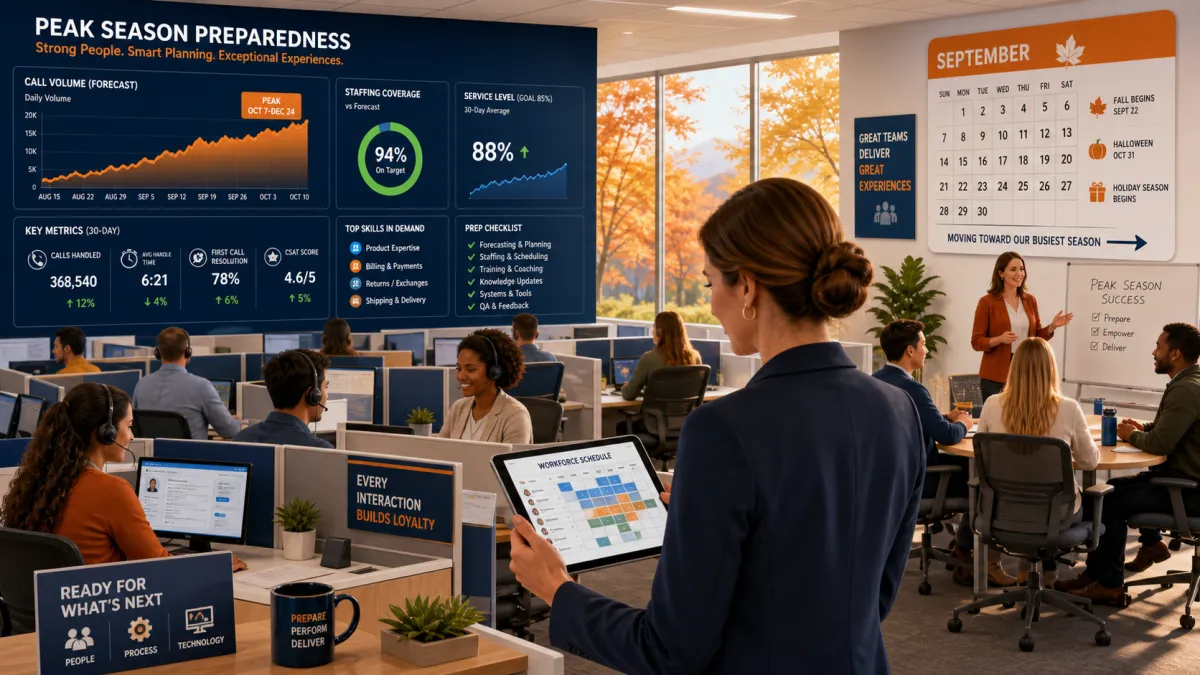
Labor Day marks the traditional kickoff of the Q4 peak season sprint for contact centers, and companies use the weeks immediately following it to lock in forecasting, staffing, technology, and process readiness before the holiday shopping surge hits. Since Labor Day sits roughly 12-14 weeks ahead of the December peak, this window is treated as the "final prep sprint" rather than the start of planning.
Forecasting and Demand Planning
Contact center leaders pull historical call, chat, and email volume data from the prior year's Black Friday through New Year period to model expected spikes, peak days, and channel mix for the upcoming season. This analysis feeds workforce management (WFM) tools that translate projected volume into hour-by-hour staffing requirements, with built-in buffer capacity such as float agents or surge teams to avoid being caught short. Leaders also use this period to set blackout dates on PTO calendars during expected peak weeks, communicating these restrictions to staff well in advance.
Staffing and Workforce Scaling
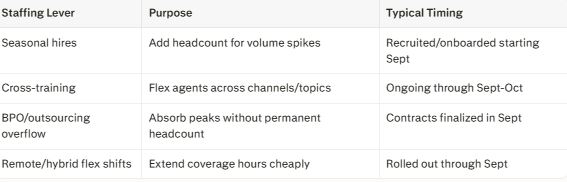
Post-Labor Day is when most operations finalize seasonal hiring, since new agents need weeks of onboarding and training before Q4 volume hits. Common scaling levers include hiring temporary or seasonal agents, cross-training existing staff across departments and channels, tapping outsourced BPO partners for overflow capacity, and enabling remote or hybrid agents to pick up extra hours. Companies increasingly avoid relying on a single site or vendor, instead spreading volume across multiple internal and outsourced locations to reduce risk of disruption.
Technology, Self-Service, and Routing Readiness
Operations refresh IVR scripts, chatbot flows, and self-service knowledge bases so routine questions (order status, shipping cutoffs, holiday hours) are deflected from live agents. Intelligent/skills-based routing and triage systems are tuned to prioritize high-impact issues, like payment disputes or delivery problems, over routine status checks. Teams also run technical redundancy checks and continuity drills, testing telecom failover, backup sites, and "what-if" scenarios (carrier outage, supplier delay, extreme volume) to stress-test systems before peak hits.
Agent Enablement and Training
Refresher training is scheduled in September and October covering updated product knowledge, holiday-specific policies, escalation protocols, and de-escalation or empathy techniques for handling stressed customers. Many operations update or rewrite scripts, macros, and canned responses to reflect new holiday promotions, return policies, and exceptions, and pair new seasonal hires with experienced agents through mentorship programs. Supervisors are also equipped with escalation and "war room" protocols to reassign agents or open overflow capacity mid-shift once volume actually spikes.
Proactive Customer Communication
Companies update IVR greetings, on-hold messaging, and outbound emails/SMS to set expectations early about holiday hours, shipping cutoffs, and possible longer wait times. This proactive messaging is designed to deflect simple inquiries before they reach a live agent, reducing overall contact volume during the actual peak.
Metrics, Monitoring, and Continuous Adjustment
Once the season begins, teams monitor real-time dashboards tracking wait time, abandonment rate, first-contact resolution, and CSAT to catch problems early, often adjusting SLA targets to reflect peak-season realities. Post-season, leaders conduct retrospectives on what worked, root causes of any failures, and feed those lessons into next year's forecasting and staffing models, closing the readiness loop before it starts again the following Labor Day.

Menu
Services
© Copyright 2023. Optimal Outcomes. All rights reserved.