Tel: 650-980-4870

Blog
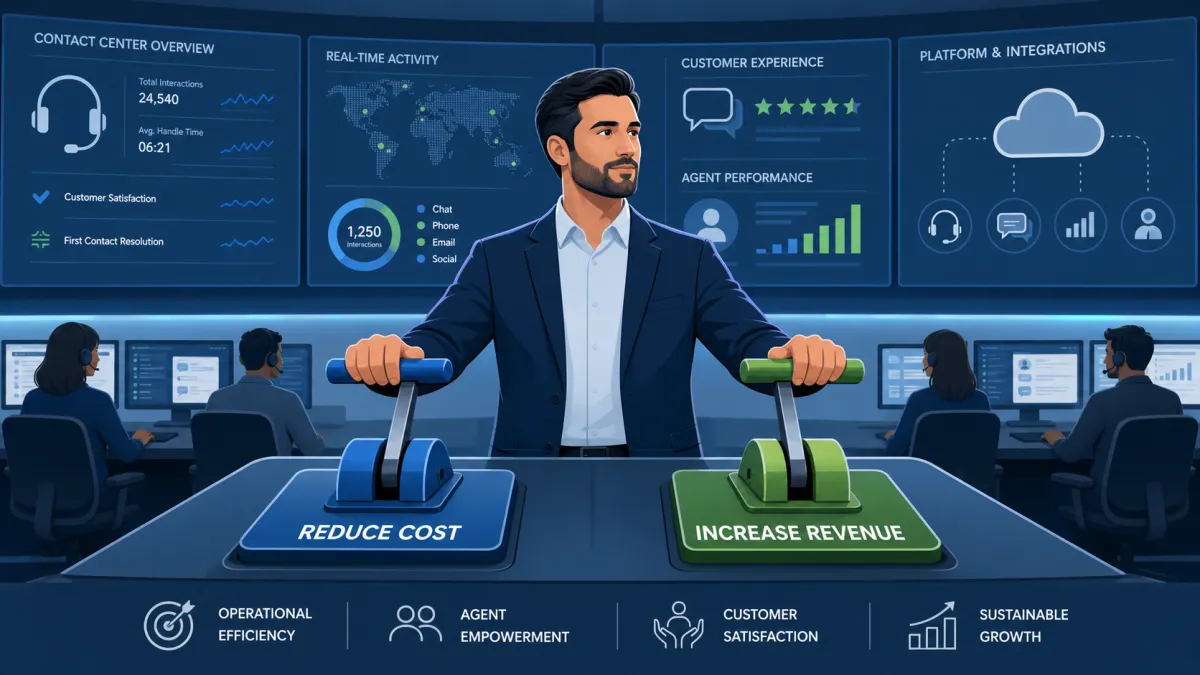
Revenue Growth and Cost Reduction
The Two Non‑Negotiables in Contact Center Leadership: Lower Cost, Grow Revenue
If you are accountable for a contact center, your job ultimately comes down to two non‑negotiable priorities: reduce costs and increase revenue. Every technology decision, every staffing move, every process change should be traceable to one or both of these goals. The good news is that there are clear, repeatable ways to find savings and unlock new revenue using tools already available in the market today.
In this post, we’ll break each priority into practical focus areas and call out where applications, systems, platforms, consultants, managed services, and outsourcing can move the needle.
Priority 1: Reduce Cost to Serve (Without Killing CX)
Cost reduction in a contact center is not about “doing the same work with fewer people.” It is about eliminating avoidable demand, automating low‑value work, and making every minute of human effort more productive.
1. Eliminate Avoidable Contacts
Every call, chat, or email that never had to happen is pure waste. Preventing those interactions is the most powerful cost lever you have.
Where to find savings:
High‑volume “where is my order,” password reset, and basic status questions.
Repeat contacts due to unclear answers, broken processes, or product defects.
How to achieve it (solutions and services):
Knowledge management and better digital content. Improving FAQs, help centers, and in‑app guidance prevents many calls at the source.
Proactive notifications. SMS, email, or in‑app alerts about shipments, outages, or delays remove the need for customers to chase you.
Consulting and CX analytics. Consultants or analytics platforms can mine interaction transcripts to identify the root causes of repeat contacts and high‑cost journeys.
2. Deflect Routine Work to Self‑Service and AI
When customers do need help, the cheapest interaction is the one they resolve themselves through intuitive self‑service. Modern AI means self‑service no longer has to feel like a brick wall.
Where to find savings:
High‑volume, rule‑based tasks: balance inquiries, address updates, simple bookings, plan changes, etc.
After‑hours volume that would otherwise require expensive staffing or overtime.
How to achieve it:
IVR and intelligent virtual agents (IVAs). Advanced IVR and AI chatbots can resolve common issues end‑to‑end and hand off gracefully to agents when needed.
Voice and digital self‑service platforms. Cloud contact center platforms now bundle bots, voice self‑service, and digital channels, making it easier to automate the top 20–40% of intents.
Managed bot services. Specialist providers can design, train, and maintain your virtual agents, accelerating time to value and avoiding internal skill gaps.
3. Make Agents Radically More Productive
Once avoidable and routine contacts are handled, your people should be focused on complex, high‑value work. Their time is expensive; squandered minutes show up directly in cost per contact.
Where to find savings:
Long handle times driven by swivel‑chairing between systems, manual note‑taking, or slow knowledge search.
Low first contact resolution (FCR) leading to callbacks and repeat contacts.
How to achieve it:
Agent assist and guidance. AI‑driven agent assist surfaces next best actions, knowledge articles, and forms in real time, cutting handle time and error rates.
CRM and system integration. Tight integration between the contact center platform, CRM, billing, and order systems removes duplicate data entry and speeds resolution.
Workforce management (WFM) tools. Modern WFM optimizes schedules, shrinkage, and adherence, reducing overstaffing while protecting service levels.
Performance coaching and training. Coaching informed by interaction analytics targets specific behaviors that drive AHT and FCR.
Consultants for process redesign. External experts can help streamline workflows, redesign scripts, and remove unnecessary steps that inflate handle time.
4. Optimize the Technology and Vendor Footprint
Many centers carry a bloated tech stack and fragmented vendor landscape. Simplifying and consolidating can unlock significant hard savings.
Where to find savings:
Duplicate functionality across point solutions for routing, recording, QA, and analytics.
Legacy on‑premises systems with high maintenance, hardware, and upgrade costs.
How to achieve it:
Cloud contact center platforms (CCaaS). Moving to cloud can reduce capex, cut maintenance, and deliver elastic scale that matches demand.
Platform consolidation. Bringing routing, WEM/WFO, analytics, and digital channels onto fewer platforms reduces licenses, support contracts, and integration costs.
Vendor management consultants. Third parties can benchmark your contracts, negotiate better pricing, and design a rationalized vendor strategy.
5. Use Strategic Outsourcing and Managed Services
Outsourcing is not just a labor arbitrage play anymore; it’s a way to vary cost with demand and buy in specialized capabilities.
Where to find savings:
Seasonal or campaign‑driven surges in volume.
Non‑core or low‑complexity queues where your brand requires less nuance.
How to achieve it:
Business process outsourcing (BPO). Use BPO partners for tier 1 support, basic back office, or off‑hours coverage to reduce fixed staffing costs.
Managed services for platforms. Offload administration, configuration, QA, and reporting of your contact center stack to managed service providers.
Hybrid models. Keep high‑value or brand‑critical interactions in‑house and push transactional work to partners, backed by shared KPIs and quality frameworks.
Priority 2: Turn the Contact Center into a Revenue Engine
Every interaction is an opportunity to protect or grow customer lifetime value. The more complex and high‑touch your business, the more revenue potential your contact center holds.
1. Enable Transactions and Revenue in Every Channel
A surprising number of “service‑only” contact centers still can’t complete a sale, upgrade, or payment within the interaction itself. Fixing that is the first step toward revenue.
Where to find revenue:
Service calls where customers ask about products, pricing, renewals, or usage.
Post‑purchase inquiries where a cross‑sell would be natural (for example, accessories or warranties).
How to achieve it:
Secure payment processing in the contact center. PCI‑compliant payment tools let agents and bots take payments safely over voice and digital channels.
Commerce and order management integration. Connecting your CCaaS with ecommerce and order systems lets agents place or modify orders in real time.
Digital selling tools in chat and messaging. Co‑browse, link sharing, and in‑channel checkout enable low‑friction sales during digital support interactions.
2. Turn Service Conversations into Sales Moments
Customers do not call to be sold to; they call to solve a problem. But if you solve the problem and then offer real, relevant value, revenue naturally follows.
Where to find revenue:
Situations where the “best fix” is actually a different product, plan, or add‑on.
Churn‑risk conversations where a tailored retention offer can save and grow the account.
How to achieve it:
“Sales through service” training. Train agents to listen for buying signals and transition to recommendations after resolving the primary issue.
Agent scripts and prompts. Dynamic scripts integrated with your desktop can nudge agents to suggest relevant products or plans based on context.
Next best offer engines. AI models can recommend the most likely‑to‑convert offer based on customer profile, interaction history, and behavior.
Incentive programs. Clear sales goals and incentives for service agents reinforce the right behaviors without turning support into hard selling.
3. Prioritize High‑Value Interactions with Intelligent Routing
Not every interaction is equal. Treating them that way leaves revenue on the table.
Where to find revenue:
Sales, retention, and high‑value customer queues that suffer from long wait times or under‑skilled staffing.
Premium segments willing to spend more when given fast, expert help.
How to achieve it:
Skills‑based and value‑based routing. Route high‑value interactions to your best closers and retention specialists.
Priority queuing for revenue‑rich intents. Use IVR and digital triage to identify buying or upgrade intent and push those interactions to the front.
Queue segmentation and SLAs. Set tighter SLAs and service levels for high‑value queues; tolerate more delay for low‑value or low‑complexity work.
4. Use Data and Analytics to Engineer More Revenue
The contact center is an insight factory. You can monetize those insights through better selling, better product, and better marketing.
Where to find revenue:
Patterns in calls that precede upgrades, churn, or big purchases.
Cross‑sell and upsell opportunities that are frequently missed by agents.
How to achieve it:
Interaction analytics and conversational intelligence. Analyze 100% of calls, chats, and messages to find language and behaviors that correlate with conversion and churn.
Closed‑loop reporting with CRM. Tie interactions to actual revenue outcomes so you can see which scripts, offers, and channels perform best.
Journey mapping and CLV modeling. Map the customer journey and quantify lifetime value to focus your best resources where the upside is highest.
Consultants and data science partners. External specialists can help design the right KPIs, dashboards, and experiments to systematically grow contact center revenue.
5. Monetize “Downtime” with Smart Outbound
Most centers experience valleys in volume. Those valleys are an opportunity to generate revenue instead of paying for idle time.
Where to find revenue:
Existing customers who are good candidates for renewals, upgrades, or add‑ons.
Prospects who abandoned carts, quotes, or applications.
How to achieve it:
Outbound dialers and campaign management. Use dialers to fill quiet periods with targeted outreach, while respecting compliance requirements.
Trigger‑based outbound. Automatically trigger follow‑up calls or messages after key events such as trial expiry, usage milestones, or NPS feedback.
Managed outbound services. Partner with specialized firms for appointment‑setting, renewals, or win‑back campaigns if you lack in‑house outbound expertise.
Putting It Together: One Strategy, Two Outcomes
The most effective leaders don’t treat cost and revenue as competing priorities; they design their contact center so that moves in one dimension support the other. For example, self‑service and AI reduce interaction volume and average handle time while freeing agents to focus on complex, high‑value conversations that drive revenue and loyalty. Similarly, better routing and sales‑through‑service training increase conversion rates while often shortening calls because agents are more confident and efficient.
Applications, platforms, consultants, managed services, and outsourcing are not strategies by themselves; they are tools. Your strategy is to relentlessly lower cost to serve and systematically grow revenue per interaction—and then select the mix of tools and partners that gets you there fastest.

Menu
Services
© Copyright 2023. Optimal Outcomes. All rights reserved.