Tel: 650-980-4870

Blog
Contact Center: Managed Services vs. In House
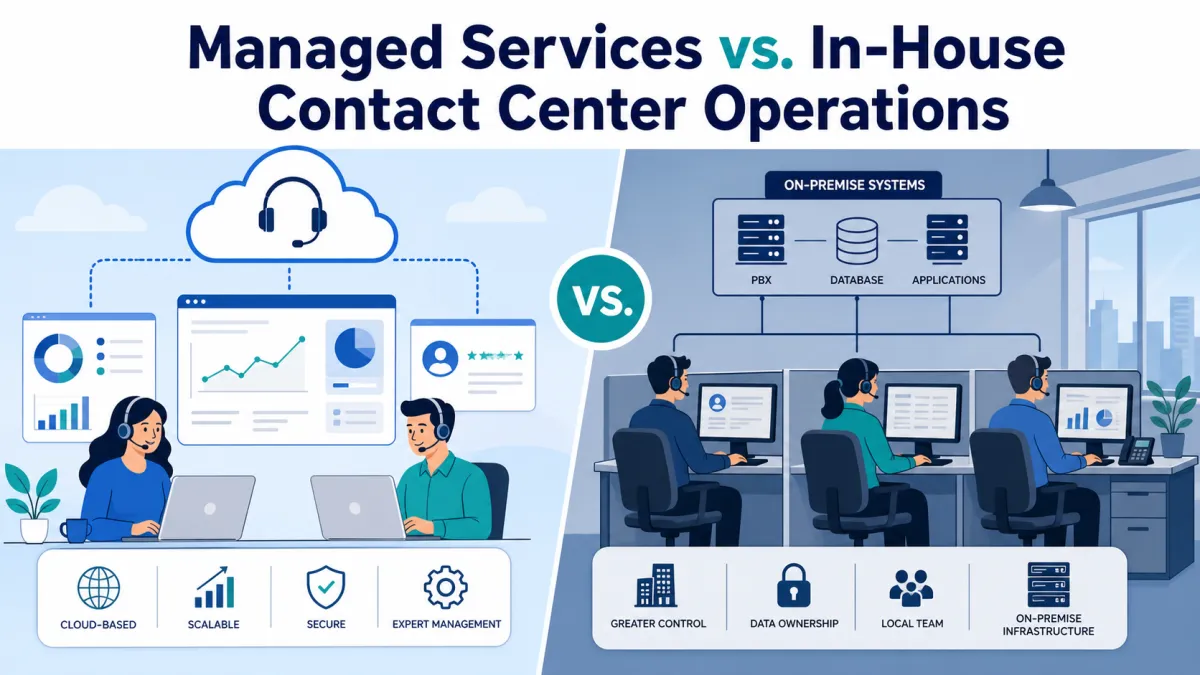
Managed services can give a contact center faster access to expertise, scalable capacity, and more predictable costs, while in‑house operations offer greater control, cultural alignment, and deeper institutional knowledge. The best choice depends on your cost structure, risk tolerance, compliance requirements, and how strategic you consider customer contact as a core competency.
Defining the Two Models
Managed services in a contact center
A managed services model means a third‑party provider operates some or all of your contact center stack and processes—such as infrastructure, platforms, workforce management, quality, or even full business process outsourcing (BPO)—under a contract and SLAs. You essentially “rent” capabilities (people, process, technology) for a recurring fee instead of owning and staffing all of it yourself.
In‑house contact center operations
An in‑house model means you staff, manage, and operate your own contact center teams and supporting technology, usually on your own platforms or within a tightly controlled enterprise architecture. You carry the responsibility for hiring, training, tools, security, and continuous improvement directly on your balance sheet.
Pros of Managed Contact Center Services
Managed service providers (MSPs) and BPOs aggregate skills, tooling, and experience across many clients, so they typically offer broader expertise than most individual enterprises can afford to build internally. They also tend to stay closer to emerging best practices, including AI, automation, and security, because innovation is core to their business model.
Key advantages include:
Cost predictability: Subscription or usage‑based pricing simplifies budgeting and can reduce surprise costs from hiring, training, and turnover.
Broad expertise: Access to specialists in workforce management, QA, analytics, security, and platform administration that a single in‑house team would struggle to match.
Scalability and flexibility: Easier to scale seats up or down for seasonality, new programs, or rapid growth without lengthy hiring cycles.
24/7 availability: Around‑the‑clock coverage and monitoring are often standard, improving resilience and uptime.
Focus on core business: Internal teams can focus on product, CX strategy, or revenue‑generating initiatives instead of infrastructure and basic operations.
Cons of Managed Contact Center Services
The flip side of outsourcing is reduced direct control and a dependency on your provider’s processes and performance. There can also be a learning curve as the vendor ramps up and builds institutional knowledge about your customers and systems.
Common drawbacks include:
Perceived loss of control: You’re relying on a third party for day‑to‑day execution, and changes must flow through contracts and governance.
Integration and context gaps: Providers need time to learn your systems, culture, and regulatory nuances; misalignment can slow early results.
Communication or transparency issues: Poorly defined SLAs, reporting, and governance can create friction and erode trust.
Limited on‑site presence: Depending on the model, hands‑on support or in‑person collaboration may be more constrained than with in‑house teams.
Contract rigidity: Multi‑year agreements can limit your ability to pivot vendors or models quickly if your strategy changes.
Pros of In‑House Contact Center Operations
In‑house operations give you full line‑of‑sight and control over your agents, processes, and technology decisions. For highly regulated, brand‑sensitive, or complex environments, this tight integration can be a significant advantage.
Major strengths include:
Full control: You own strategy, staffing, process, and technology end‑to‑end, enabling bespoke workflows and rapid internal reprioritization.
Deep institutional knowledge: Teams embedded in your business understand your products, policies, and culture at a deeper level.
Closer collaboration: Proximity to product, marketing, and operations makes it easier to co‑create CX improvements and feedback loops.
Data governance: Keeping data and systems inside your own infrastructure can simplify some compliance and risk concerns.
Cons of In‑House Contact Center Operations
Owning operations also means owning the full cost and complexity of building and maintaining talent, platforms, and governance. As volumes or channels expand, gaps in 24/7 coverage, specialized skills, or tooling can become significant constraints.
Key challenges include:
Higher fixed costs: Salaries, benefits, facilities, licenses, and continuous training create large, ongoing investments.
Hiring and retention issues: Competition for skilled CX, IT, and analytics talent can slow growth and drive up costs.
Limited coverage and resilience: Smaller internal teams may struggle with 24/7 coverage, redundancy, and disaster recovery.
Slower scalability: Adding channels, languages, or new programs requires recruitment, onboarding, and sometimes new leadership layers.
Risk of skill stagnation: Without constant exposure to broader market practices, in‑house teams can fall behind in AI, automation, and security.
When Managed Services Make Sense
Managed services tend to be a strong fit when organizations need to control costs, scale quickly, or access capabilities they cannot efficiently build themselves. They can also accelerate modernization when legacy infrastructure, technical debt, or limited internal bandwidth is blocking CX improvement.
Common scenarios where managed models shine:
Midmarket companies lacking depth in workforce management, QA, AI, or security but needing enterprise‑grade resilience.
Rapid growth or seasonal demand that makes hiring, training, and facility management impractical.
Multi‑site, multi‑time‑zone operations that require 24/7 coverage and centralized monitoring.
Organizations prioritizing speed to value with new platforms, channels, or automation initiatives.
When In‑House Makes Sense
In‑house operations are often favored when CX is seen as a strategic differentiator that leadership wants to tightly own and cultivate. This is especially true where there are complex products, tight regulatory scrutiny, or a strong preference for keeping customer data and processes internal.
Typical situations where in‑house is advantageous:
Highly specialized or technical support where agents need deep product immersion.
Industries with strict data residency or regulatory requirements that make broad outsourcing complex.
Organizations with strong internal IT and CX teams already in place and invested in modern platforms.
Cultures that value direct leadership over frontline staff and prefer bespoke processes over standardized vendor playbooks.
Hybrid and Co‑Managed Models
Many organizations land on a hybrid approach, keeping strategic or high‑complexity functions in‑house while outsourcing specific workloads, channels, or enabling services. Co‑managed models can blend the control of in‑house with the flexibility and coverage of managed services.
Examples of hybrid configurations include:
In‑house core team with managed overflow and after‑hours support.
Internal leadership and QA, with a managed workforce for routine interactions or specific geographies.
In‑house agents but managed services for technology operations, security, and analytics.

Menu
Services
© Copyright 2023. Optimal Outcomes. All rights reserved.