Tel: 650-980-4870

Blog
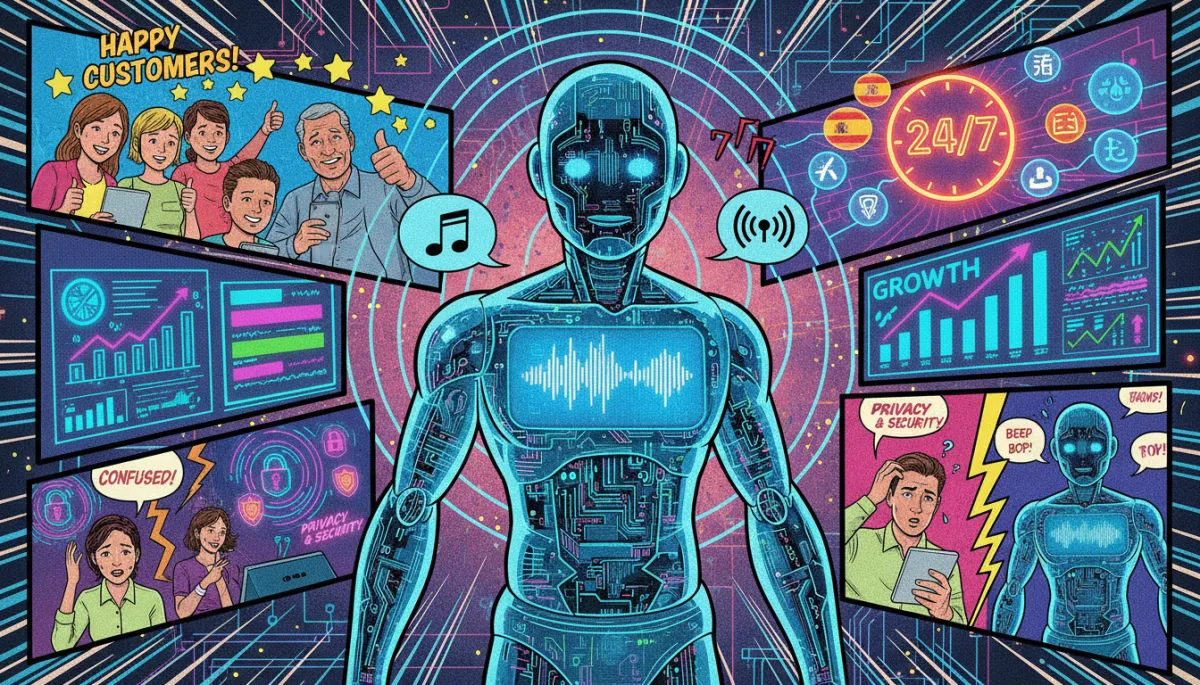
AI Voice Agents
AI Voice Agents: Transforming Communication in the Digital Age
Artificial Intelligence voice agents have rapidly evolved from simple voice assistants to sophisticated conversational partners capable of handling complex interactions. These AI-powered systems are reshaping how businesses and consumers communicate, offering unprecedented opportunities while presenting unique challenges that organizations must navigate.
What Are AI Voice Agents?
AI voice agents are intelligent systems that use natural language processing (NLP), speech recognition, and machine learning to understand, process, and respond to human speech. Unlike traditional interactive voice response (IVR) systems, modern AI voice agents can engage in natural, context-aware conversations, understand intent, and adapt their responses based on the interaction flow.
Key Benefits
1. 24/7 Availability and Scalability
AI voice agents never sleep, providing round-the-clock customer support without the constraints of human work schedules. They can handle thousands of simultaneous conversations, scaling instantly during peak demand periods without additional staffing costs.
2. Cost Efficiency
By automating routine inquiries and transactions, businesses can significantly reduce operational costs. Studies suggest that AI voice agents can handle up to 80% of standard customer service interactions, freeing human agents to focus on complex, high-value tasks.
3. Consistent Customer Experience
Voice agents deliver uniform service quality across every interaction, eliminating variability in tone, accuracy, or helpfulness that can occur with human agents having different training levels or experiencing fatigue.
4. Multilingual Capabilities
Advanced AI voice agents can seamlessly switch between languages, breaking down communication barriers and enabling businesses to serve global markets without maintaining multilingual support teams.
5. Data-Driven Insights
Every interaction generates valuable data about customer preferences, pain points, and behavior patterns. This intelligence helps businesses optimize their services and personalize future interactions.
Significant Challenges
1. Understanding Context and Nuance
Despite advances in NLP, AI voice agents still struggle with sarcasm, emotional subtleties, regional dialects, and complex contextual references that humans navigate effortlessly. Misunderstandings can lead to customer frustration and poor experiences.
2. Privacy and Security Concerns
Voice interactions involve sensitive personal data. Organizations must ensure robust security measures, comply with regulations like GDPR, and maintain customer trust regarding how voice data is stored, processed, and used.
3. The Uncanny Valley Effect
When voice agents sound almost—but not quite—human, they can create discomfort. Striking the right balance between natural-sounding speech and transparent AI identity remains challenging.
4. Integration Complexity
Implementing AI voice agents requires integration with existing CRM systems, databases, and workflows. Legacy systems may not be compatible, requiring significant technical investment and organizational change management.
5. Handling Emotional Situations
AI voice agents lack genuine empathy. In sensitive situations—such as healthcare concerns, financial distress, or complaint resolution—customers often prefer human interaction that demonstrates authentic understanding and compassion.
6. Bias and Fairness
AI systems can inadvertently perpetuate biases present in their training data, potentially leading to discriminatory outcomes in voice recognition accuracy across different accents, genders, or age groups.
The Path Forward
The future of AI voice agents lies in hybrid models that combine AI efficiency with human expertise. Smart routing systems can direct straightforward queries to AI while escalating complex or emotional situations to human agents. Continuous learning mechanisms allow voice agents to improve over time, learning from both successful and failed interactions.
Organizations implementing AI voice agents should prioritize transparency, clearly informing customers when they're interacting with AI. They must also invest in ongoing training and refinement, ensuring their voice agents evolve alongside customer expectations and technological capabilities.
Conclusion
AI voice agents represent a transformative technology with the potential to revolutionize customer service, healthcare, education, and countless other sectors. While the benefits of scalability, efficiency, and accessibility are compelling, organizations must thoughtfully address challenges around accuracy, privacy, and human connection. Success requires not just technological sophistication, but a human-centered approach that recognizes when AI enhances experiences and when human touch remains irreplaceable.
As these systems continue to mature, the question isn't whether AI voice agents will become ubiquitous—it's how we'll design them to serve humanity's best interests while respecting our need for genuine connection and understanding.

Menu
Services
© Copyright 2023. Optimal Outcomes. All rights reserved.