Tel: 650-980-4870

Blog
Managing Risk
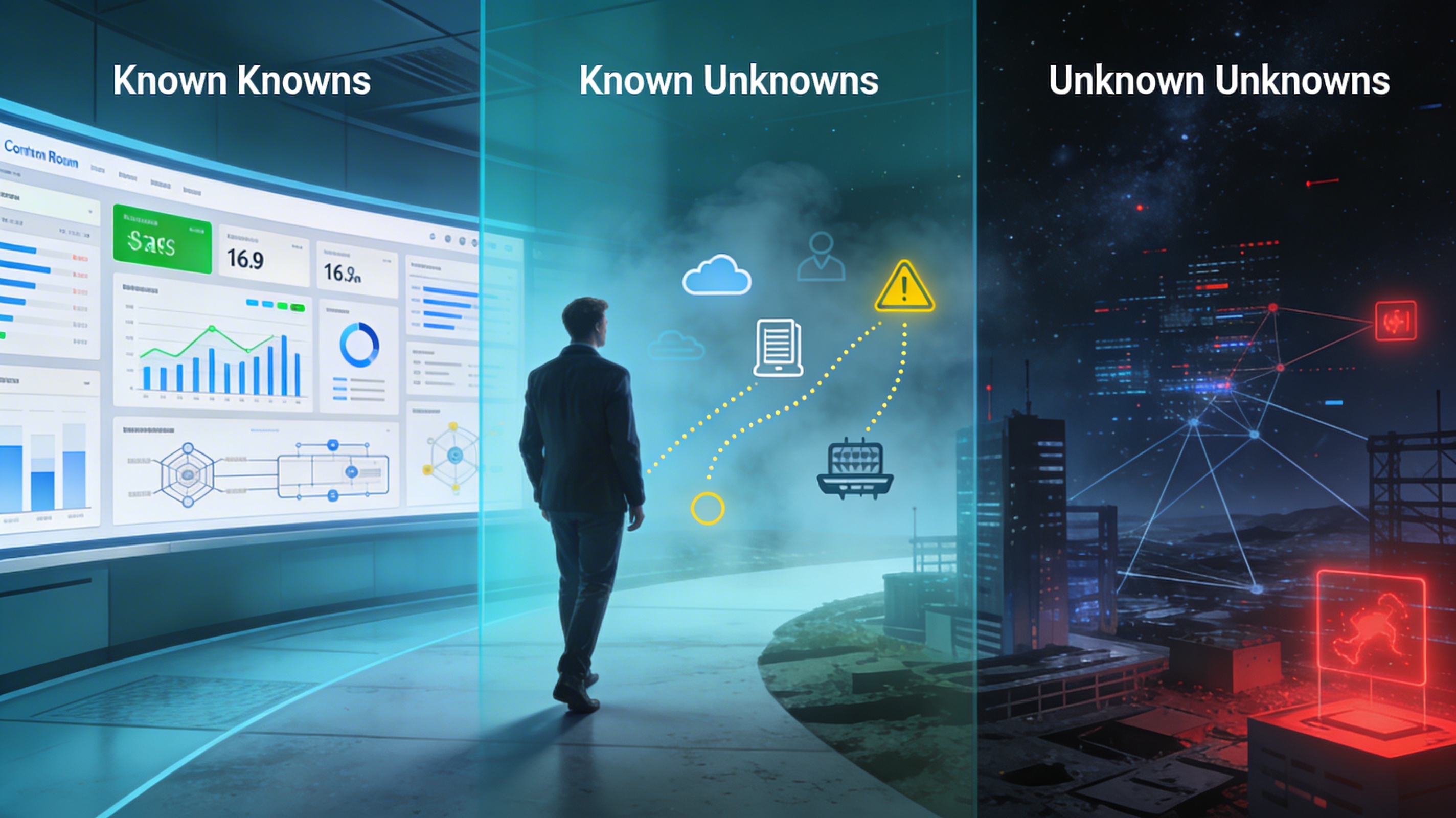
Modern technology decisions are made in a landscape defined by three kinds of risk: what you clearly understand, what you know you do not fully understand, and what will blindside you after go‑live. Framing decisions around “known knowns, known unknowns, and unknown unknowns” provides a practical way to protect the organization and keep operations running as smoothly as possible.
Known knowns: what you can and must nail down
Known knowns are the factors you understand well enough to describe, measure, and design controls around before you sign a contract or deploy. In technology, this is where disciplined due diligence and architecture rigor pay off.
Examples of known knowns in a tech decision:
Defined business requirements and success metrics (SLAs, uptime, response times, CX/KPI targets).
Regulatory, security, and data residency obligations you are already subject to.
Existing infrastructure, integrations, skills, and constraints in your environment.
How to handle them when deciding and operating:
Translate requirements into concrete contractual SLAs, security controls, and non‑functional specs.
Map clear ownership (RACI) for operations, incident response, and change management.
Instrument the environment with monitoring, logging, and reporting that directly measures those requirements.
Known unknowns: what you can see but not fully quantify
Known unknowns are risks you know exist, but cannot precisely predict in advance: you “know that you don’t know” how they will manifest. In IT, these include new threat vectors, evolving workloads, and user behaviors that will only become clear in production.
Typical known unknowns around technology choices:
New feature use cases, traffic patterns, or integrations that will emerge over 12–24 months.
Future regulatory or contract changes that could affect data handling or retention.
Attack techniques against your stack that have not yet been seen but are plausible.
How to handle them both pre‑decision and in operations:
Design with headroom: modular architecture, API‑first integration, and capacity buffers.
Use continuous risk assessment and threat intelligence to update controls over time.
Run periodic game days, failover tests, and incident simulations to validate response capability.
Unknown unknowns: what will blindside you
Unknown unknowns are the surprises: risks and failure modes you were not even considering when you designed or purchased the technology. These often emerge from complex interactions between systems, vendors, people, and external events.
Characteristics of unknown unknowns in tech operations:
Novel attack paths using combinations of systems in ways designers did not anticipate.
Data quality or behavior anomalies that monitoring was not explicitly configured to detect.
Cascading failures across dependencies (cloud regions, third‑party APIs, network carriers).
How to make the organization resilient when you cannot predict specifics:
Build adaptive, resilient systems: graceful degradation, bulkheads, and automated rollback.
Invest in anomaly‑detection and AI‑driven monitoring that can surface “weird” patterns, not just known signatures.
Institutionalize learning loops: blameless post‑mortems, root‑cause analysis, and design changes after every incident.
From decision to steady‑state: operating model for all three
The real differentiator is not the initial technology decision, but the operating model that continuously manages all three categories of risk. The goal is to convert as many unknown unknowns as possible into known unknowns, and known unknowns into known knowns you can manage.
Key operating practices once the decision is made:
Governance: a cross‑functional risk forum (IT, security, operations, business) that regularly reviews metrics, incidents, and emerging risks.
Observability: end‑to‑end telemetry (logs, metrics, traces, user experience) with clear SLOs and alerting.
Preparedness: tabletop exercises, disaster recovery simulations, and chaos testing to reveal hidden weaknesses.
Culture: reward transparent reporting of issues and near‑misses so signals are surfaced early instead of buried.
Bringing it together for technology leaders
Rumsfeld’s “known knowns, known unknowns, unknown unknowns” may have originated in geopolitics, but it has become a useful shorthand in risk and technology management. Technology leaders who consciously categorize risks this way can make more robust decisions, negotiate better with vendors, and design operating environments that bend under stress instead of breaking.

Menu
Services
© Copyright 2023. Optimal Outcomes. All rights reserved.