Tel: 650-980-4870

Blog
UCaaS: Pure Cloud vs. Hybrid
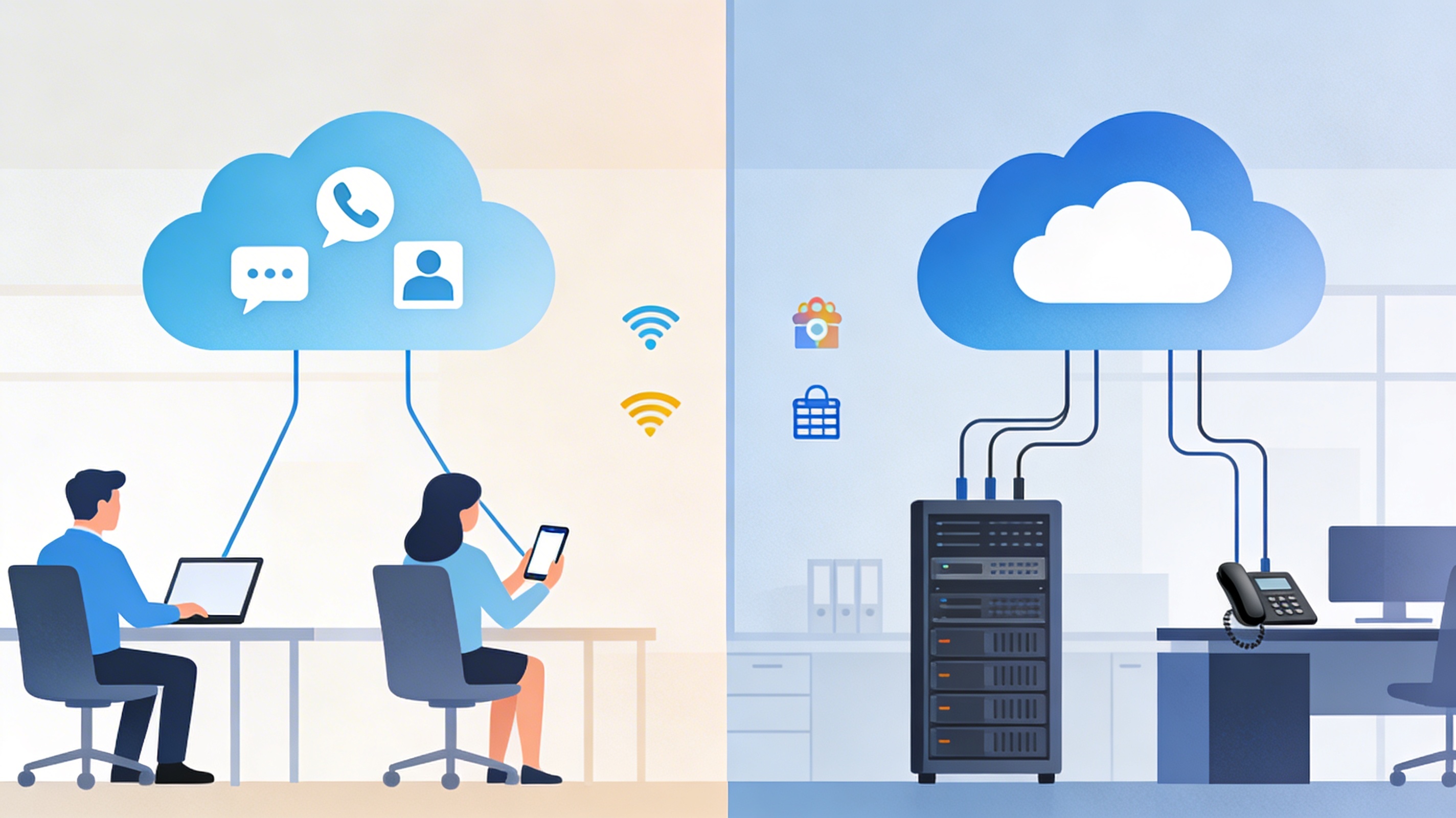
Pure cloud UCaaS is usually the best long‑term fit for agility and simplicity, while hybrid UCaaS makes sense when you have hard constraints around uptime, regulation, or existing investments that you can’t rip and replace yet.
Definitions in plain English
Pure cloud UCaaS: All core UC services (voice, meetings, messaging, contact center) are hosted in the provider’s cloud, delivered over the internet, with no call control or UC servers on your premises.
Hybrid UCaaS: Some functions stay on‑premises or in your own data center (e.g., call control, trunks, 911 routing), while others (collaboration, softphones, AI, analytics) are delivered from the cloud.
Why organizations choose pure cloud
Faster deployment and scaling: You spin up users, sites, and features in days instead of months; scaling for new locations or seasonal staff is almost linear—add licenses and devices, not hardware.
Lower operational overhead: The provider manages upgrades, patches, security, and capacity, so your IT team focuses on higher‑value work instead of babysitting PBXs and SIP infrastructure.
Continuous innovation: New features (AI assistants, meeting enhancements, analytics) appear automatically without forklift upgrades or maintenance windows.
Predictable costs: Per‑user subscription with bundled calling often replaces capex on servers, SBCs, and data center space, plus reduces on‑site maintenance.
Best suited for: Distributed and remote‑heavy workforces, fast‑growing firms, organizations without strict data‑residency rules, and those wanting to standardize globally on one platform.
Why organizations choose hybrid
On‑site survivability and resilience: Local call controllers or gateways can keep internal calling and sometimes PSTN access running even when the WAN or cloud link is down.
Regulatory and 911 control: You can keep local control of emergency routing, call recording, and data storage to meet HIPAA, PCI, and location‑specific 911 requirements while still using cloud for collaboration.
Leverage existing investments: You can keep a functional PBX, analog endpoints, paging, or contact center infrastructure at core sites and layer cloud services on top, instead of ripping everything out at once.
Gradual migration path: Common pattern is to keep HQ on‑prem while moving branches and remote workers fully into the cloud, migrating additional sites as contracts and hardware age out.
Best suited for: Hospitals and healthcare, financial services, large retailers, and manufacturers with plants or warehouses where uptime and local control are critical.
Key differences at a glance
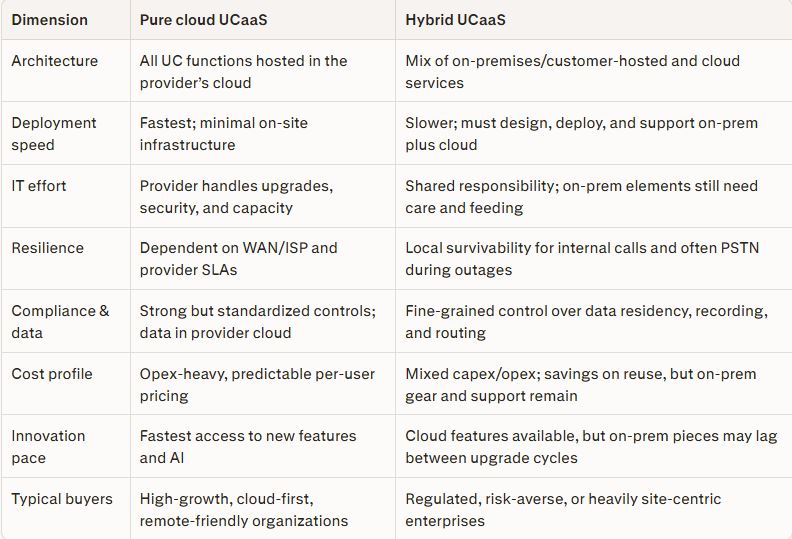
How to choose: a simple decision lens
Use these questions with stakeholders:
How critical is local survivability?
If a WAN outage cannot interrupt internal calling, plant operations, or certain clinical workflows, hybrid or at least local survivability gateways are important.
What are your regulatory and 911 obligations?
Strict rules for call recording, data residency, and location‑specific 911 handling push you toward hybrid so you can keep sensitive workloads on‑prem or in your own cloud.
What is your IT capacity and strategy?
If you want to offload as much as possible and shrink the data center footprint, pure cloud aligns best.
If you have skilled telecom/network staff and existing platforms you can’t immediately retire, hybrid lets you modernize without losing sunk value.
What’s your migration horizon?
A 6–12 month refresh window often justifies going all‑in on pure cloud.
A 2–5 year phased strategy across many sites often benefits from a hybrid approach, starting with branches and remote users while core sites migrate later.
An effective way to frame this in your blog is: pure cloud is the default for most UCaaS roadmaps, while hybrid is a deliberate strategy for organizations with specific operational, regulatory, or infrastructure realities that cloud alone can’t fully address yet.

Menu
Services
© Copyright 2023. Optimal Outcomes. All rights reserved.